

Đề thi HSGQG THPT 2026 môn Tiếng Anh (Có đáp án)
In ancient Egypt, numbers were conveyed through repeated glyphs, with distinct symbols assigned to increasing magnitudes: one to nine appeared simply as (26)_____, while new symbols denoted 10, 100, and 1,000. Although the Egyptians lacked a symbol for zero, their reliance on (27)_______ of ten revealed a clear commitment to base-10 logic, in which numerical patterns reset at each power of ten.
Babylonian numerals arose from the physical constraints of cuneiform inscription. Rather than applying (28)_______ to papyrus, scribes impressed symbols into clay by means of a pen-shaped (29)_______, which limited graphical variety. Their base-60 system, while visually opaque to modern observers, enabled sophisticated calculations far beyond base 10.
The Maya achieved extraordinary efficiency by constructing an entire numerical language from only three signs: a dot, a line, and a shell. Operating within a base-20 framework with numbers reaching (30)_______ in a single position, their system uniquely incorporated zero and featured place value organised (31)_______.
The Inca developed an entirely non-written method through the quipu, encoding quantities with a (32)_______ and precisely arranged (33)_______. Despite its tactile nature, the system adhered to base-10 counting.
Finally, Roman numerals – (34)_______ letters in the same language governed by addition and (35)_______ principles – marked a significant conceptual innovation.
 18 trang
31/01/2026
1510
18 trang
31/01/2026
1510
Tóm tắt nội dung tài liệu: Đề thi HSGQG THPT 2026 môn Tiếng Anh (Có đáp án)
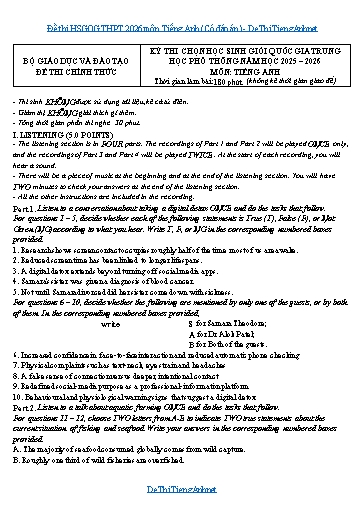
 Đề thi HSGQG THPT 2026 môn Tiếng Anh (Có đáp án) - DeThiTiengAnh.net
 KỲ THI CHỌN HỌC SINH GIỎI QUỐC GIA TRUNG
 BỘ GIÁO DỤC VÀ ĐÀO TẠO HỌC PHỔ THÔNG NĂM HỌC 2025 – 2026
 ĐỀ THI CHÍNH THỨC MÔN: TIẾNG ANH
 Thời gian làm bài: 180 phút (không kể thời gian giao đề)
- Thí sinh KHÔNG được sử dụng tài liệu,kể cả từ điển.
- Giám thị KHÔNG giải thích gì thêm.
- Tổng thời gian phần thi nghe: 30 phút.
I. LISTENING (5.0 POINTS)
- The listening section is in FOUR parts. The recordings of Part 1 and Part 2 will be played ONCE only,
and the recordings of Part 3 and Part 4 will be played TWICE. At the start of each recording, you will
hear a sound.
- There will be a piece of music at the beginning and at the end of the listening section. You will have
TWO minutes to check your answers at the end of the listening section.
- All the other instructions are included in the recording.
Part 1. Listen to a conversation about taking a digital detox ONCE and do the tasks that follow.
For questions 1 – 5, decide whether each of the following statements is True (T), False (F), or Not
Given (NG) according to what you hear. Write T, F, or NG in the corresponding numbered boxes
provided.
1. Research shows screen contact occupies roughly half of the time most of us are awake.
2. Reduced screen time has been linked to longer lifespans.
3. A digital detox extends beyond turning off social media apps.
4. Samara's sister was given a diagnosis of blood cancer.
5. Not until Samara divorced did her sister come down with sickness.
For questions 6 – 10, decide whether the following are mentioned by only one of the guests, or by both
of them. In the corresponding numbered boxes provided,
 write S for Samara Theodore;
 A for Dr Alok Patel;
 B for Both of the guests.
6. Increased confidence in face-to-face interaction and reduced automatic phone checking
7. Physical complaints such as text-neck, eye strain and headaches
8. A false sense of connection versus deeper, intentional contact
9. Redefined social-media purpose as a professional-information platform
10. Behavioural and physiological warning signs that suggest a digital detox
Part 2. Listen to a talk about aquatic farming ONCE and do the tasks that follow.
For questions 11 – 12, choose TWO letters from A-E to indicate TWO true statements about the
current situation of fishing and seafood. Write your answers in the corresponding numbered boxes
provided.
A. The majority of seafood consumed globally comes from wild capture.
B. Roughly one third of wild fisheries are overfished.
 DeThiTiengAnh.net Đề thi HSGQG THPT 2026 môn Tiếng Anh (Có đáp án) - DeThiTiengAnh.net
C. Aquaculture currently accounts for nearly half of the seafood consumed worldwide.
D. The quantity of seafood produced through aquatic farming is experiencing annual growth.
E. Antibiotics-free practices are implemented across all fish farming operations.
For questions 13 – 15, choose THREE letters from A-G to indicate THREE true statements about the
current situation of net pens. Write your answers in the corresponding numbered boxes provided.
A. Net pens typically cover an area of approximately one square kilometre.
B. Escapes from net pens are rare occurrences.
C. Net pens in Chile and Norway are crammed with fish.
D. Net pen farms are predominantly situated in freshwater environments.
E. Waste from net pen farms can pollute surrounding waters and spread disease to wild species. F.
Antibiotics used in net pens are fully metabolised by the fish and do not enter the environment.
G. The main aim of net pen farms is to increase populations of endangered fish species.
For questions 16 – 20, write the letter A, B, C or D in the corresponding numbered boxes provided to
indicate the correct answer to each of the following questions according to what is stated or implied by
the speaker.
16. Mangroves and marshes do all of the following EXCEPT ______.
A. protecting coastal areas from storms B. providing essential habitats
C. supporting the construction of coastal ponds D. taking in huge amounts of greenhouse gases
17. Which of the following is NOT an advantage of fully contained inland fish farms?
A. Reducing disease risks B. Preventing water pollution
C. Recirculating water D. Minimising reliance on fishmeal
18. Approximately ______ of the global seafood catch is used for animal feed.
A. 5% B. 10% C. 15% D. 20%
19. What is the key advantage of cultivating shellfish and seaweeds?
A. Their high market value and strong profitability
B. Their fast growth rates and quick harvesting cycles
C. Their minimal need for feed and benefit to water health
D. Their ability to thrive in contained systems and reduce pollution
20. The example of Washington State was mentioned in order to ______.
A. illustrate the potential of restorative ocean farming to meet global food demands
B. highlight the geographic limitations of implementing regenerative ocean farming
C. demonstrate the enormous scale of the problem of unsustainable aquaculture
D. compare the environmental impact of different aquaculture systems worldwide
Part 3. For questions 21 – 25, listen to part of a talk about walking backwards, or retro-walking,
TWICE and answer each of the following questions with no more than TWO words taken from the
recording. Write your answers in the corresponding spaces provided.
21. What word refers to the joint problem backwards-walking might help alleviate?
_________________________________________________________________________
22. What do improved lower body and back strength contribute to?
_________________________________________________________________________
 DeThiTiengAnh.net Đề thi HSGQG THPT 2026 môn Tiếng Anh (Có đáp án) - DeThiTiengAnh.net
23. What condition related to backache does retro-walking aim to relieve?
_________________________________________________________________________
24. What is the term for the altered movement pattern beneficial to knee-injury recovery?
_________________________________________________________________________
25. What is reported to improve, as reflected by the accelerated response speed during retro-walking?
_________________________________________________________________________
Part 4. For questions 26 – 35, listen to part of a talk about numerical systems TWICE, and complete
the following summary with no more than ONE word and/or A number taken from the recording for
each space. Write your answers in the corresponding numbered boxes provided.
 In ancient Egypt, numbers were conveyed through repeated glyphs, with distinct symbols assigned to
increasing magnitudes: one to nine appeared simply as (26)_____, while new symbols denoted 10, 100, and
1,000. Although the Egyptians lacked a symbol for zero, their reliance on (27)_______ of ten revealed a
clear commitment to base-10 logic, in which numerical patterns reset at each power of ten.
 Babylonian numerals arose from the physical constraints of cuneiform inscription. Rather than
applying (28)_______ to papyrus, scribes impressed symbols into clay by means of a pen-shaped
(29)_______, which limited graphical variety. Their base-60 system, while visually opaque to modern
observers, enabled sophisticated calculations far beyond base 10.
 The Maya achieved extraordinary efficiency by constructing an entire numerical language from
only three signs: a dot, a line, and a shell. Operating within a base-20 framework with numbers reaching
(30)_______ in a single position, their system uniquely incorporated zero and featured place value
organised (31)_______.
 The Inca developed an entirely non-written method through the quipu, encoding quantities with a
(32)_______ and precisely arranged (33)_______. Despite its tactile nature, the system adhered to base-
10 counting.
 Finally, Roman numerals – (34)_______ letters in the same language governed by addition and
(35)_______ principles – marked a significant conceptual innovation.
II. READING (8.0 points)
II.1. LANGUAGE IN USE (3.0 points)
Part 1. For questions 36 – 40, read the passage below and decide which answer (A, B, C, or D) best fits
each space. Write the letter A, B, C, or D in the corresponding numbered boxes provided.
 Chaos and order are two of the most fundamental elements of lived experience – (36)_____. But
they’re not things, or objects, and they’re not experienced as such. Things or objects are part of the
objective world. They’re inanimate; spiritless. They’re dead. This is not true of chaos and order. Those
are perceived, experienced and understood (to the degree that they are understood at all) as personalities –
and that is just as true of the perceptions, experiences and understanding of modern people as their
ancient forebears. It’s just (37)______.
 Order and chaos are not understood first, objectively (as things or objects), and then personified.
(38)____, and then inferred intent and purpose. But that isn’t how perception operates, despite our
preconceptions. Perception of things as tools, for example, occurs before or in concert with perception of
things as objects. We see what things mean (39)______. Perception of things as entities with personality
 DeThiTiengAnh.net Đề thi HSGQG THPT 2026 môn Tiếng Anh (Có đáp án) - DeThiTiengAnh.net
also occurs before perception of things as things. This is particularly true of the action of others, living
others, but we also see the non-living “objective world” as animated, with purpose and intent.
(40)________ “the hyperactive agency detector” within us. We evolved, over millennia, within intensely
social circumstances. This means that the most significant elements of our environment of origin were
personalities, not things, objects or situations.
 (Adapted from 12 Rules for Life by Jordan B. Peterson)
36. A. two of the basics subdivided by Being itself
B. two of the most basic subdivisions of Being itself
C. two ways of subdividing the most basic Being itself
D. two times as much as the basic subdivisions of Being itself
37. A. that moderners don’t notice B. what is unnoticeable to moderners
C. that isn’t modernly noticeable D. whatever comes to moderners’ notice
38. A. We would be the only case if the perceived reality were objective
B. That would only be the case if we perceived objective reality first
C. Our objective would be the first to perceive the reality of each case
D. Only when we first perceived the case in reality could we be objective
39. A. faster in their seeing just what we are
B. just as fast as or faster than their seeing
C. just as fast as or faster than we see what they are
D. the fastest possible just in our seeing what they are
40. A. The operation, because it is called by psychologists
B. In view of the operation of what psychologists have called
C. Operationally, owing to the fact that psychologists have called this
D. This is because of the operation of what psychologists have called
Part 2. For questions 41 – 45, read the passage below and decide which answer (A, B, C, or D) best fits
each space. Write the letter A, B, C, or D in the corresponding numbered boxes provided.
 The escalating climate crisis is no longer solely an environmental concern; it’s (41)________
impacting the mental wellbeing of a generation. A 2021 Lancet Planetary Health survey revealed that a
significant 60% of young people aged 16-25 report considerable worry about climate change, with nearly
half admitting this anxiety interferes with their daily life. This isn’t simply fear of immediate physical
threats, but deep-seated (42)________ for the good old days that are slipping away.
 While the physical health impacts of climate change receive considerable attention, the
psychological toll, especially among youth, is increasingly evident. Studies demonstrate a correlation
between climate-related disasters and (43)________ rates of post-traumatic stress disorder, depression,
and learning difficulties – notably observed in Pakistan following the 2010 floods, where three-quarters
of children experienced educational setbacks.
 Beyond direct trauma, anticipatory anxiety fuelled by perceived inaction from older generations is
prevalent, manifested in panic attacks, insomnia, and obsessive thoughts. As psychiatrist Lise Van
Susteren notes, this engenders a sense of “(44)________ injustice”, leaving young people feeling
betrayed and abandoned. Recognising the growing mental health crisis linked to climate change,
 DeThiTiengAnh.net Đề thi HSGQG THPT 2026 môn Tiếng Anh (Có đáp án) - DeThiTiengAnh.net
organisations are prioritising “climate-aware” professionals and resources. They acknowledge the deeply
personal impact and are committed to (45)________ to understand and mitigate the rising psychological
toll of anxiety and trauma on affected populations.
 (Adapted from https://www.magazine.hms.harvard.edu)
41. A. solemnly B. profusely C. profoundly D. intensely
42. A. pain B. strain C. dread D. grief
43. A. amplified B. elevated C. intensified D. extended
44. A. interracial B. intermediary C. interdisciplinary D. intergenerational
45. A. going the extra mile B. leaving nothing to chance
C. being on the lookout D. working by the book
Part 3. For questions 46 – 50, complete the passage by filling in each space with one of the words
given in the box in its correct form. There are FOUR extra words.
 CENTRE SPEED ACCELERATE DISSIPATE REPUTED
 COMBINATION VANISH STAR ORBIT COALESCENT
 In medieval workshops alchemists chased the fantasy of transmuting lead into gold, their (0)
reputation today reduced to that of (46)________ antiquarians. What they could not foresee, however, is
that the coveted metal is not a product of earthly chemistry at all but a relic of cosmic cataclysms. Gold was
forged in the fiery crucible of supernovae, the explosive deaths of massive stars. After billions of years of
hydrogen fusion that successively builds helium, carbon, oxygen and, ultimately, iron, the stellar core can
no longer sustain energy production. The ensuing collapse drives protons and electrons into neutrons, and a
torrent of neutrons bombards iron-group nuclei, synthesising ever heavier elements – silver, gold, lead,
uranium – within seconds. The blast ejects this enriched matter into (47)________ space. There it mingles
with gas and dust that later (48)________ into new planetary systems; Earth's own gold arrived in this
manner and was later concentrated by geothermal processes into veins we now mine.
 Modern particle (49)________ can replicate such nucleosynthesis atom by atom, but the cost and
timescale render the method economically absurd. Oceanic waters contain roughly 20 million tonnes of
dissolved gold, yet its (50)________ low concentration precludes extraction. Future prospects may lie in
extraterrestrial mining or, improbably, a nearby supernova that showers our planet with fresh treasure –
provided it spares life itself.
Part 4. The passage below contains SIX grammatical mistakes. The first one, (0), has been identified.
For questions 51 – 55, UNDERLINE the remaining FIVE mistakes and WRITE THEIR CORRECT
FORMS.
 Leonardo da Vinci’s 16th-century invention, the “Miter Lock” – a system of two V-shaped, hinged
(0) gate that close automatically using water pressure – still underpin the Panama Canal’s lock system.
When a current strikes an open leaf, the inclined faces force the gates together, producing a watertight
seal. As the downstream water level rises, the resulting pressure tightens the joint until leakage ceases. To
open the lock, engineers first equalise the water levels on both sides by opening the sluice valves. This
balance suggests that only a modestly manual effort – usually a single operator on each leaf – should be
required to swing the gates wide enough for vessels to pass.
 DeThiTiengAnh.net Đề thi HSGQG THPT 2026 môn Tiếng Anh (Có đáp án) - DeThiTiengAnh.net
 The modern gates, some weighing 730 tonnes, are moved by a large wheel linked to steel supports
– a system that worked for 84 years before being replaced by hydraulic cylinders. As the gates are
hollow, buoyancy can offset much of their weight; as a result, the massive hinges experience less strain
and last longer. Their narrow edges concentrate pressure, causing the seals to become stronger and
minimise leakage. Da Vinci also anticipated leakage beneath the gates, proposing a stepping surface that
the water-driven gate almost touches, preventing bottom leakage and ensuring a complete seal. Thus, a
Renaissance invention continues to demonstrate its relevance in one of the world’s most remarkable
engineering feats.
Your answers:
 0. gate -> gates
II.2. READING COMPREHENSION (5.0 points)
Part 1. For questions 56 – 65, read the following passage and fill in each of the numbered spaces with
ONE suitable word. Write your answers in the corresponding numbered boxes provided.
 A recent study shows that briefly changing the way people see their own bodies can make it easier
to recall autobiographical memories, including some from early childhood. The study, led by
neuroscientists in Cambridge, involved 50 adult volunteers. The experiment used what is known as an
"enfacement (56)_______," a technique that helps people feel as though another face they see on a(n)
(57)________ is actually their own reflection.
 Each participant watched a live video of their own face that was digitally modified with an image
filter to resemble how they might have looked as a child. As participants (58)_______ their heads, the on-
screen image mirrored their movements, creating the sensation that the childlike face was truly theirs. A
control group experienced the (59)_______ setup but viewed their unaltered adult faces. After completing
the illusion, participants were asked to take part in a(n) (60)_______ memory interview designed to
prompt (61)_______ from both their early life and the previous year.
 The findings revealed that people who saw the younger version of (62)_______ remembered
significantly more detailed events from childhood than those who saw their regular adult face. The results
provide the first evidence that subtle changes in bodily self-perception can influence how deeply we
(63)_______ distant memories.
 According to the researchers, this discovery sheds new light on how our (64)_______ of the body
interacts with memory. It could eventually lead to new methods for accessing forgotten or hard-to-reach
memories, including those from the period known as "childhood amnesia," which typically covers the
(65)_______ few years of life.
 (Adapted from https://www.sciencedaily.com)
Part 2. For questions 66 – 72, rearrange the following sentences from A-H in order to make a
complete and meaningful passage. Write your answers (A-H) in the corresponding numbered boxes
provided. The first one, (0), has been done as an example.
 DeThiTiengAnh.net Đề thi HSGQG THPT 2026 môn Tiếng Anh (Có đáp án) - DeThiTiengAnh.net
A. Mozzarella, a quintessential Italian cheese cherished worldwide for its creamy texture and subtly
sweet flavour, elevates everything from pizza to salad with its irresistible charm and culinary applications
across continents today.
B. A skilled cheesemaker wields a wooden paddle, expertly adding just enough water and gently
stretching the curd until it achieves the smooth, elastic consistency characteristic of true mozzarella in the
hand.
C. In the cheese-making process, the milk is gently warmed, combined with enzymes and a starter culture
of lactic-acid bacteria, which ferment lactose into acid and cause the milk to coagulate into curds.
D. Now that the mozzarella has taken its final shape, it stands as a cornerstone of Italian gastronomy,
embodying the art, tradition, and passion that have defined its production for centuries and continue to
inspire chefs worldwide.
E. The journey begins on verdant dairy farms where well-treated cows and buffalo graze on rich pastures,
producing high-quality milk that forms the essential base for mozzarella’s unique taste and aroma throughout.
F. So, when you savour a melt-in-your-mouth bite of mozzarella, remember the patient, precise, and
passionate journey from farm-fresh milk to the perfect, silky melt that makes every bite unforgettable on
your plate.
G. The curds are then cut into small pieces to regulate moisture, followed by a warm-water bath with a
pinch of salt that enhances flavour and prepares the mass for kneading.
H. The freshly formed cheese is shaped into a bowl or ball; its fresh milky aroma fills the air as it cools,
ready to become the star of any dish you choose.
 (Adapted from How It's Made: Mozzarella cheese, https://www.youtube.com)
Part 3: Read the following passage and do the tasks that follow.
 BATTLE OF THE GENERATIONS
A. Should a mother have favourites, or should she be equally altruistic towards all her children? The word
‘favourite’ carries no subjective connotations, and the word ‘should’ no moral ones. I am treating a
mother as a machine programmed to do everything in its power to propagate copies of the genes which
ride inside it. Since you and I are humans who know what it is like to have conscious purposes, it is
convenient for me to use the language of purpose as a metaphor in explaining the behaviour of survival
machines. In practice, what would it mean to say a mother had a favourite child? It would mean she
would invest her resources unequally among her children. The resources that a mother has available to
invest consist of a variety of things. Food is the obvious one, together with the effort expended in
gathering food, since this in itself costs the mother something. Risk undergone in protecting young from
predators is another resource which the mother can ‘spend’ or refuse to spend. Energy and time devoted
to nest or home maintenance, protection from the elements, and, in some species, time spent in teaching
children, are valuable resources which a parent can allocate to children, equally or unequally as she
‘chooses’. Measuring these diverse resources in a common currency is challenging; while calories or
energy costs offer a tempting metric, they only loosely correspond to the true “gold standard” of
evolution: gene survival. R. L. Trivers, in 1972, elegantly addressed this with his concept of Parental
Investment, echoing ideas Sir Ronald Fisher had suggested in 1930 with his notion of “parental
expenditure.”
 DeThiTiengAnh.net Đề thi HSGQG THPT 2026 môn Tiếng Anh (Có đáp án) - DeThiTiengAnh.net
B. Parental Investment (P.I.) is defined as ‘any investment by the parent in an individual offspring that
increases the offspring’s chance of surviving (and hence reproductive success) at the cost of the parent’s
ability to invest in other offspring.’ The beauty of Trivers’s parental investment is that it is measured in
units very close to the units that really matter. When a child uses up some of its mother’s milk, the
amount of milk consumed is measured not in pints, not in calories, but in units of detriment to other
children of the same mother. For instance, if a mother has two babies, X and Y, and X drinks one pint of
milk, a major part of the P.I. that this pint represents is measured in units of increased probability that Y
will not survive because he did not drink that pint. P.I. is measured in units of decrease in life expectancy
of other children, born or yet to be born. Parental investment is not quite an ideal measure, because it
overemphasises the importance of parentage, as against other genetic relationships. Ideally we should use
a generalised altruism investment measure. Individual A may be said to invest in individual B, when A
increases B’s chance of surviving, at the cost of A’s ability to invest in other individuals including herself,
all costs being weighted by the appropriate relatedness. Thus a parent’s investment in any one child
should ideally be measured in terms of detriment to life expectancy not only of other children, but also of
nephews, nieces, herself, etc. In many respects, however, this is just a quibble, and Trivers’s measure is
well worth using in practice.
C. Now any particular adult individual has, in her whole lifetime, a certain total quantity of P.I. available
to invest in children (and other relatives and in herself, but for simplicity we consider only children). This
represents the sum of all the food she can gather or manufacture in a lifetime of work, all the risks she is
prepared to take, and all the energy and effort that she is able to put into the welfare of children. How
should a young female, setting out on her adult life, invest her life’s resources? What would be a wise
investment policy for her to follow? According to the Lack theory, she should not spread her investment
too thinly among too many children. That way she will lose too many genes: she won’t have enough
grandchildren. On the other hand, she must not devote all her investment to too few children – spoilt
brats. She may virtually guarantee herself some grandchildren, but rivals who invest in the optimum
number of children will end up with more grandchildren. So much for even-handed investment policies.
Our present interest is in whether it could ever pay a mother to invest unequally among her children, i.e.
in whether she should have favourites.
Dưới đây là nội dung văn bản được trích xuất từ hình ảnh của bạn. Bạn có thể sao chép toàn bộ nội dung
này và dán vào Microsoft Word để sử dụng.
D. The answer is that there is no genetic reason for a mother to have favourites. Her relatedness to all her
children is the same, 1/2. Her optimal strategy is to invest equally in the largest number of children that
she can rear to the age when they have children of their own. But, as we have already seen, some
individuals are better life insurance risks than others. An under-sized runt bears just as many of his
mother’s genes as his more thriving litter mates. But his life expectation is less. Another way to put this is
that he needs more than his fair share of parental investment, just to end up equal to his brothers.
Depending on circumstances, however, a mother may redirect the portion of parental investment that
would be allocated to a less viable offspring toward her other children, thereby increasing the resources
available to them. In some cases, the investment earmarked for the weaker individual is simply
transferred to its siblings, enhancing their chances of survival. In a few animal species mothers sometimes
 DeThiTiengAnh.net Đề thi HSGQG THPT 2026 môn Tiếng Anh (Có đáp án) - DeThiTiengAnh.net
exhibit extreme behaviours toward their young, but such actions are rare and not specifically targeted at
the runts.
 (Adapted from The Selfish Gene by Richard Dawkins)
For questions 73 – 79, decide whether each of the following statements is True (T), False (F) or Not
Given (NG). Write T, F, or NG in the corresponding numbered boxes provided.
73. A mother’s favourite child is defined as the one with the highest genetic value.
74. Parental investment can be quantified in a way that closely reflects its evolutionary impact.
75. Trivers’s concept of parental investment overstates parental relationships out of proportion to other
genetic connections.
76. Ideally, the measure of parental investment should incorporate parents’ own survival as well as the
survival of other relatives.
77. A mother’s total resources include all the energy, effort, and time she can expend on children
throughout her lifetime.
78. Equal parental investment guarantees maximum reproductive success for a mother.
79. Runts generally require additional parental investment just to match their siblings’ survival chances.
For questions 80 – 87, choose from the sections (A-D). The sections may be selected more than once.
Write the letter A, B, C, or D in the corresponding numbered boxes provided.
Which section _______?
80. points out that a mother’s genetic stake in each child is the same
81. calls for a universal metric that weighs a recipient’s gain against the donor’s loss
82. mentions the framing of maternal behaviour in mechanistic, purpose-oriented terms
83. warns that an over-dispersed allocation of resources can undermine reproductive payoff
84. notes that unequal favouritism toward one child may diminish the prospects of the others
85. discusses the difficulty of representing varied maternal resources in a single evolutionary metric
86. mentions that in some species, mothers occasionally neglect their young for no particular reason
87. alludes to the fact that maternal input blends hands-on effort with an instructional aspect in tending
offspring
Part 4. Read the following passage and do the tasks that follow.
 THE RELIGION OF DATAISM
1. Dataism says that the universe consists of data flows, and the value of any phenomenon or entity is
determined by its contribution to data processing. This may strike you as some eccentric fringe notion,
but in fact it has already conquered most of the scientific establishment. Dataism was born from the
explosive confluence of two scientific tidal waves. In the 150 years since Charles Darwin published On
the Origin of Species, the life sciences have come to see organisms as biochemical algorithms.
Simultaneously, in the eight decades since Alan Turing formulated the idea of a Turing Machine,
computer scientists have learned to engineer increasingly sophisticated electronic algorithms. Dataism
puts the two together, pointing out that exactly the same mathematical laws apply to both biochemical
and electronic algorithms. Dataism thereby collapses the barrier between animals and machines, and
expects electronic algorithms to eventually decipher and outperform biochemical algorithms.
 DeThiTiengAnh.net Đề thi HSGQG THPT 2026 môn Tiếng Anh (Có đáp án) - DeThiTiengAnh.net
2. For politicians, business people and ordinary consumers, Dataism offers groundbreaking technologies
and immense new powers. For scholars and intellectuals it also promises to provide the “scientific holy
grail” that has eluded us for centuries: a single overarching theory that unifies all the scientific disciplines
from literature and musicology to economics and biology. [I] According to Dataism, King Lear and the
flu virus are just two pa1tterns of data flow that can be analysed using the same basic concepts and tools.
This2 idea is extremely attr3active. It gives all scientists a common language, builds bridges over
academic rifts and easily exports insights acr4oss disciplinary borders. Musicologists, pol5itical scientists
and cell biologists can finally understand each other.67
3. In the process, Datai8sm inverts the traditional pyramid of learning. Hitherto9, data was seen as only
the first step in a long chain of intellectual activity. Humans were supposed to distil data into information,
information into knowledge, and knowledge into wisdom. However, Dataists believe that humans can no
lon10ger cope with the immense flows of data, hence they cannot distil data into information, let alone
into knowledge or wisdom. [II] The work of processing data should therefore be entrusted to electronic
algorithms, whose capacity far exceeds that of the human brain. In practice, this means11 that Datais12ts
are sceptical about human knowledge and wisdom, and prefer to put their trust in Big Data and computer
algorithms.
4. Dataism is most firmly entrenched in its two mother disciplines: computer science and biology. Of the
two, biology is the more important. It was the biological embracement of Dataism that turned a limited
breakthrough in computer science into a world-shattering cataclysm that may completely transform the
very nature of life. You may not agree with the idea that organisms are algorithms, and that giraffes,
tomatoes and human beings are just different methods for processing data. But you should know that this
is current scientific dogma, and that it is changing our world beyond recognition.
5. Not only individual organisms are seen today as data-processing systems, but also entire societies such
as beehives, bacteria colonies, forests and human cities. [III] Laypeople believe that the economy
consists of peasants growing wheat, workers manufacturing clothes, and customers buying bread and
underpants. Yet experts see the economy as a mechanism for gathering data about desires and abilities,
and turning this data into decisions.
6. According to this view, free-market capitalism and the centrally-administered economic model aren't
competing ideologies, ethical creeds or political institutions. [IV] At bottom, they are competing data-
processing systems. The former model uses distributed processing, whereas the latter one relies on
centralised processing. Capitalism processes data by directly connecting all producers and consumers to
one another, and allowing them to exchange information freely and make decisions independently. For
example, how do you determine the price of bread in a free market? Well, every bakery may produce as
much bread as it likes, and charge for it as much as it wants. The customers are equally free to buy as
much bread as they can afford, or take their business to the competitor. It isn't illegal to charge $1,000 for
a baguette, but nobody is likely to buy it.
7. On a much grander scale, if investors predict increased demand for bread, they will buy shares of
biotech firms that genetically engineer more prolific wheat strains. The inflow of capital will enable the
firms to speed up their research, thereby providing more wheat faster, and averting bread shortages. Even
if one biotech giant adopts a flawed theory and reaches an impasse, its more successful competitors will
 DeThiTiengAnh.net
File đính kèm:
- de_thi_hsgqg_thpt_2026_mon_tieng_anh_co_dap_an.docx

