

Bộ 7 Đề thi thử Tiếng Anh THPT 2022-2026 SGD Tuyên Quang (Có đáp án)
Cultural Diversity in the Workplace
Cultural diversity in the workplace is becoming more important as businesses expand globally.
People from different cultural backgrounds bring unique perspectives, ideas, and experiences, (1) . A diverse team offers a range of skills, which allows companies to solve problems more creatively. (2) , they can learn from each other's experiences, bringing about more open-minded and adaptable individuals. This can create a more dynamic and productive work environment, improving overall team performance.
However, cultural diversity also brings challenges. (3) . Employees may struggle to work together effectively if they do not understand each other's cultural backgrounds. To address these challenges, companies need to foster a supportive environment that encourages respect and inclusion.
Training programs that teach cultural awareness can help employees better understand their colleagues' perspectives and working methods. In addition, promoting open communication and organizing team-building activities (4) .
In conclusion, cultural diversity in the office provides many benefits, but it requires effort from both employers and employees to make it work effectively. By embracing cultural differences and fostering an inclusive workplace, companies can create an environment where all employees feel valued and respected.
(5) . A diverse and inclusive office culture helps build a positive work environment and enhances overall performance, leading to long-term growth and success.
(Adapted from THINK)
Question 1.
A. led to better decision-making and innovative solutions
B. leading to innovative solutions and better decision-making
C. that can result in better decision-making and innovative solutions
D. to which causes better solutions and innovative decision-making
Question 2.
A. Although employees from various cultural backgrounds collaborate
B. When employees from various cultural backgrounds collaborate
C. So long as employers from various cultural backgrounds collaborate
D. In order to collaborate employees from various cultural backgrounds
Question 3.
A. Work ethic values, communication styles, and misunderstandings can give rise to different conflicts
B. Differences in communication styles, and values which can cause misunderstandings or conflicts
C. Differences in communication styles, work ethics, and values can result in conflicts or misunderstandings
D. Communication styles, work ethics, and value misunderstandings or conflicts can generate differences
Question 4.
A. the strengthened relationships help reduce the chances of conflict
B. can strengthen relationships and reduce the chances of conflict
C. strengthened relationships to reduce the chances of conflict
D. strengthening relationships to reduce the chances of conflict
Question 5.
A. This not only improves teamwork but also contributes to the company's success
B. These improve teamwork so that they contribute to the company's success
C. What improves teamwork can contribute to the company's success and productivity
D. Improving teamwork contributes to the company's success and productivity
 102 trang
26/05/2026
2840
102 trang
26/05/2026
2840
Tóm tắt nội dung tài liệu: Bộ 7 Đề thi thử Tiếng Anh THPT 2022-2026 SGD Tuyên Quang (Có đáp án)
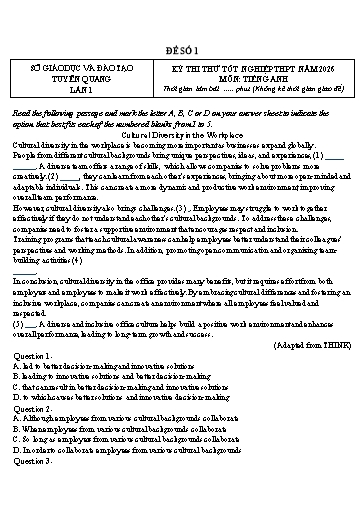
 ĐỀ SỐ 1
 SỞ GIÁO DỤC VÀ ĐÀO TẠO KỲ THI THỬ TỐT NGHIỆP THPT NĂM 2026
 TUYÊN QUANG MÔN: TIẾNG ANH
 LẦN 1 Thời gian làm bài: ..... phút (Không kể thời gian giao đề)
Read the following passage and mark the letter A, B, C or D on your answer sheet to indicate the
option that best fits each of the numbered blanks from 1 to 5.
 Cultural Diversity in the Workplace
Cultural diversity in the workplace is becoming more important as businesses expand globally.
People from different cultural backgrounds bring unique perspectives, ideas, and experiences, (1)
 . A diverse team offers a range of skills, which allows companies to solve problems more
creatively. (2) , they can learn from each other's experiences, bringing about more open-minded and
adaptable individuals. This can create a more dynamic and productive work environment, improving
overall team performance.
However, cultural diversity also brings challenges. (3) . Employees may struggle to work together
effectively if they do not understand each other's cultural backgrounds. To address these challenges,
companies need to foster a supportive environment that encourages respect and inclusion.
Training programs that teach cultural awareness can help employees better understand their colleagues'
perspectives and working methods. In addition, promoting open communication and organizing team-
building activities (4)
 .
In conclusion, cultural diversity in the office provides many benefits, but it requires effort from both
employers and employees to make it work effectively. By embracing cultural differences and fostering an
inclusive workplace, companies can create an environment where all employees feel valued and
respected.
(5) . A diverse and inclusive office culture helps build a positive work environment and enhances
overall performance, leading to long-term growth and success.
 (Adapted from THINK)
Question 1.
A. led to better decision-making and innovative solutions
B. leading to innovative solutions and better decision-making
C. that can result in better decision-making and innovative solutions
D. to which causes better solutions and innovative decision-making
Question 2.
A. Although employees from various cultural backgrounds collaborate
B. When employees from various cultural backgrounds collaborate
C. So long as employers from various cultural backgrounds collaborate
D. In order to collaborate employees from various cultural backgrounds
Question 3. A. Work ethic values, communication styles, and misunderstandings can give rise to different conflicts
B. Differences in communication styles, and values which can cause misunderstandings or conflicts
C. Differences in communication styles, work ethics, and values can result in conflicts or
misunderstandings
D. Communication styles, work ethics, and value misunderstandings or conflicts can generate differences
Question 4.
A. the strengthened relationships help reduce the chances of conflict
B. can strengthen relationships and reduce the chances of conflict
C. strengthened relationships to reduce the chances of conflict
D. strengthening relationships to reduce the chances of conflict
Question 5.
A. This not only improves teamwork but also contributes to the company's success
B. These improve teamwork so that they contribute to the company's success
C. What improves teamwork can contribute to the company's success and productivity
D. Improving teamwork contributes to the company's success and productivity
Read the following announcement and mark the letter A, B, C, or D on your answer sheet to indicate
the option that best fits each of the numbered blanks from 6 to 11.
 Vietnam Heritage Fashion Showcase 2026 – Preserving Tradition in a Modern World
The Vietnam Heritage Fashion Showcase 2026 will be organised in London from September 19 to 21,
introducing the iconic Ao Dai to a wider international audience. The programme features a series of
cultural events (6)
aim to celebrate Vietnamese heritage while encouraging creative exchange with global designers.
(7) by the Vietnamese Embassy in the UK, the showcase is expected to attract fashion professionals,
cultural experts, and art enthusiasts from across Europe.
During the exhibition, visitors will have the opportunity to (8) about traditional handicrafts and
gain deeper insight into the craftsmanship behind silk weaving and ceramic production. The event also
emphasises that the Ao Dai (9) a vital role in representing national identity and artistic expression.
Organisers hope the showcase will (10) into a sustainable cultural platform, enabling Vietnamese
artisans to present their stories (11) to the international community.
 (Adapted from https://en. vietnamplus. vn)
Question 6.
A. where B. what C. who D. which
Question 7.
A. To sponsor B. Sponsor C. Sponsoring D. Sponsored
Question 8.
A. look up B. get away C. put up D. find out
Question 9.
A. gives B. makes C. holds D. plays
Question 10.
A. develop B. raise C. increase D. rise Question 11.
A. effectiveness B. effect C. effective D. effectively
Read the passage and mark the letter A, B, C or D on your answer sheet to indicate the best answer to
each of the following questions from 12 to 21.
Fast fashion's appeal rests on speed and novelty, but the costs are dispersed across oceans and
atmospheres. [I] Polyester-heavy garments leach microfibers during washing; dye effluents overwhelm
rivers near manufacturing hubs; and overproduction ensures that surplus inventory becomes landfill
fodder or is incinerated. Brands tout capsule "conscious" lines, yet throughput targets remain unaltered,
meaning marginal efficiency gains are swamped by absolute volume, perpetuating systemic
environmental degradation and deepening long-term ecological inequities worldwide. Such dynamics
reveal a production model structurally predicated on acceleration and disposability, wherein ecological
costs are externalized, regulatory asymmetries persist across borders, and vulnerable populations remain
disproportionately exposed to the cumulative burdens of extraction, pollution, and climate volatility.
Supply chains, optimized for immediacy, rely on subcontracting lattices that outstrip public oversight. [II]
When price points race downward, environmental externalities and labor protections are the first to be
shaved off. Claims
of circularity, absent durable design and infrastructure for large-scale recirculation, are marketing gloss
rather than material transformation. Meanwhile, the logistics of reverse supply – collection, sorting, fiber-
to-fiber recycling –struggle to keep pace with the torrent of low-grade blends that resist reprocessing,
thereby perpetuating systemic waste, obscuring accountability, and delaying substantive structural reform
across the industry. This persistent lag between extraction and recovery underscores how efficiency
rhetoric masks structural imbalances, allowing
production to expand unchecked while remediation systems remain chronically underfunded,
technologicallyconstrained, and institutionally fragmented across jurisdictions.
Consumer behavior complicates any remedy. [III] Social-media cycles fetishize perpetual newness,
converting wardrobes into content pipelines; discount platforms train shoppers to treat clothes as near-
disposable. Policy can counteract these incentives – extended producer responsibility, eco-modulated
fees, and right-to-repair rules – but enforcement gaps and jurisdictional patchworks dilute impact.
Retailers experiment with rental and resale, only to discover that additional channels often cannibalize
quality while leaving aggregate volume largely intact, suggesting that without recalibrating demand itself,
incremental reforms risk being absorbed by the very growth dynamics they seek to restrain and ultimately
failing to curb the sector's escalating material footprint.
What endures, then, beyond seasonal campaigns, is a structural arithmetic. [IV] Without binding caps
on production and credible emissions accounting, sustainability talk risks net-greenwashing:
relative improvements advertised as planetary salvation. The sector's outsized water draw, chemical
intensity, and fossil-fuel dependency cannot be reconciled with breakneck turnover unless growth
becomes materially decoupled from throughput – a prospect that, so far, appears aspirational rather than
achieved, and one that demands coordinated regulatory resolve, transparent metrics, and a fundamental
reorientation of value away from volume-driven expansion toward genuine long-term ecological stability.
 (Adapted from Earth. org, “Fast Fashion and Its Environmental Impact in 2025”) Question 12. The word “unaltered” in paragraph 1 is OPPOSITE in meaning to .
A. maintained B. modified C. preserved D. unchanged
Question 13. The word “torrent” in paragraph 2 is closest in meaning to .
A. a relatively small amount B. a short and brief interruption
C. a generally stable condition D. a rapid and overwhelming flow
Question 14. The word “these” in paragraph 3 refers to .
A. enforcement gaps and jurisdictional patchworks
B. social media trends and discount-driven consumer habits
C. rental and resale experiments in global markets
D. sustainability campaigns and environmental initiatives
Question 15. Which of the following is NOT mentioned in the passage?
A. Noise pollution from textile factories
B. Microfiber pollution from washing polyester
C. River contamination from dye effluents
D. Incineration of surplus inventory
Question 16. Where in the passage would the following sentence best fit?
This inflation of claims risks widening the gap between corporate messaging and biophysical limits,
inviting regulatory and consumer backlash.
A. [IV] B. [I] C. [II] D. [III]
Question 17. Which of the following best summarises paragraph 2?
A. Recycling systems effectively manage all forms of textile waste in the globe.
B. Marketing strategies have completely transformed the fashion industry globally.
C. Complex supply chains and weak recycling infrastructure undermine sustainability claims.
D. Fast fashion supply chains are transparent and straightforward to regulate globally.
Question 19. Which of the following best paraphrases the underlined sentence in paragraph 4?
Without binding caps on production and credible emissions accounting, sustainability talk risks net-
greenwashing: relative improvements advertised as planetary salvation.
A. Emissions accounting has minimal impact on meaningful environmental protection in the long run.
B. Sustainability discussions are unnecessary within the fashion industry today in the current context.
C. Production caps alone are enough to guarantee long-term sustainability without requiring additional
measures.
D. Strict production limits and transparent emissions reporting prevent misleading environmental claims.
Question 20. Which of the following can be inferred from the passage?
A. Government policies are strictly enforced worldwide and effectively protect public interests.
B. Minor efficiency improvements are insufficient to address the environmental damage of fast fashion.
C. Consumers are fully informed about supply chain conditions and aware of environmental problems.
D. Growth in fashion production has already been separated from environmental impact.
Question 21. Which of the following best summarises the entire passage?
A. Recycling innovations will eliminate textile waste in the foreseeable future across the global fashion
industry. B. Fast fashion can become sustainable through improved marketing strategies alone without major
structural reforms.
C. Structural overproduction, weak regulation, and consumer habits make sustainability largely
superficial.
D. Consumer behavior alone ultimately determines overall environmental outcomes in both rich and poor
countries.
Mark the letter A, B, C or D on your answer sheet to indicate the best arrangement of utterances or
sentences to make a cohesive and coherent exchange or text in each of the following questions from 22
to 26.
Question 22
a. Hoa: I completely agree. However, teachers should still guide students to use it responsibly.
b. Nam: That's true. AI is automating many tasks, from data analysis to customer service, which may
significantly
reduce the need for certain jobs
c. Hoa: Many experts believe that artificial intelligence will transform the job market in the near future.
Do you share
that opinion?
Question 18. Which of the following statements is TRUE according to the passage?
A. Lower prices often lead to weaker environmental and labor standards
B. Rental and resale always reduce overall clothing production worldwide
C. Recycling infrastructure keeps pace with textile waste in many fashion companies
D. Sustainability campaigns have ended overproduction on a large scale
A. b - c - a B. c - b - a C. b - a - c D. c - a - b
Question 23.
Dear Members of the School Board,
a. Tentatively titled "Unity Day," this event is designed to provide students with opportunities to develop
essential skills such as teamwork, communication, and leadership.
b. We look forward to receiving your support and guidance to make this meaningful initiative a reality.
c. To ensure feasibility, we have also planned to allocate a reasonable budget for materials and prizes
from the Union's fund.
d. I am writing to formally propose organising a school-wide event to foster community spirit and active
involvement among students.
e. Given the clear objectives and preparation mentioned above, we respectfully seek your approval to
proceed with this plan.
Yours sincerely, Le Van Nam - President of the Students' Union
A. d - a - c - e - b B. d - c - a - e - b C. a - d - c - e - b D. a - d - e - c - b
Question 24
a. Tom: I enjoy playing the guitar. It helps me unwind after a long day.
b. Jerry: I've recently taken up painting. It's a great way to express creativity. How about you?
c. Jerry: That's cool! Music is definitely good for mental health d. Tom: You seem very relaxed lately. Do you have any new hobbies?
e. Tom: Exactly. It keeps my mind sharp and stress-free.
A. d - a - b - c - e B. b - a - c - e - d C. d - b - a - c - e D. a - b - c - d - e
Question 25.
a. Conversely, the lack of face-to-face interaction can lead to feelings of isolation and weaken team
cohesion over time.
b. Remote work has become a dominant trend in the modern corporate world, presenting both clear
advantages and significant challenges.
c. Furthermore, without a clear boundary between professional and personal life, many employees
struggle with burnout and overworking.
d. Proponents argue that it offers unmatched flexibility, eliminating daily commutes and allowing for a
better work-life balance.
e. Ultimately, companies need to adopt hybrid models that maximize the benefits while mitigating the
downsides of working from home.
A. d - b - c - a - e B. d - a - c - e - b C. b - d - a - c - e D. b - a - c - d - e
Question 26.
a. These limitations have led many educators to question whether examinations alone can accurately
reflect a learner's
true abilities.
b. Examinations remain one of the most widely used methods of assessment worldwide, verifying
whether students
are ready to progress to the next stage of education.
c. In response to these concerns, some institutions have introduced alternative forms of evaluation, such
as coursework and project-based assessment, to provide a more balanced measure of achievement.
d. Despite their practicality and perceived fairness, exams may encourage superficial learning, as some
candidates focus mainly on tested content rather than deep understanding.
e. For this reason, while exams continue to play an important role, they should be carefully designed and
supplemented with other assessment methods to ensure greater validity.
A. d - b - c - a - e B. b - a - d - c - e C. b - d - a - c - e D. d - b - a - c - e
Read the following leaflet and mark the letter A, B, C, or D on your answer sheet to indicate the option
that best fits each of the numbered blanks from 27 to 32.
 How to Improve the Quality of Education?
Improving the quality of education is the duty of not only teachers but also (27) student in the school
community. In today's competitive and technology-driven world, education is of great importance in
shaping future generations. Small positive habits can make a big (28) in students' academic
performance and personal development. For example, learners should develop effective study routines
and manage their time wisely.
Another important step is to encourage schools to create (29) that boost creativity and critical
thinking. In addition, students should actively participate (30) classroom discussions and
collaborative projects to enhance their communication skills. Parents and teachers should also work together to organise extracurricular (31) such as workshops,
competitions, and career orientation programmes. (32) these activities help students discover their
strengths and prepare better for future challenges.
 (Adapted from articles on quality education – UNESCO, https://www. unesco. org)
Question 27.
A. another B. many C. every D. all
Question 28.
A. selection B. arrangement C. attempt D. difference
Question 29.
A. learning supportive environments B. supportive environments learning
C. supportive learning environments D. environments supportive learning
Question 30.
A. in B. at C. on D. with
Question 31.
A. missions B. activities C. operations D. campaigns
Question 32.
A. because B. therefore C. however D. although
Read the following passage and mark the letter A, B, C, or D on your answer sheet to indicate the best
answer to each of the following questions from 33 to 40.
The concept of obtaining fresh water from an iceberg that is towed to populated areas and arid regions of
the world was once treated as a joke more appropriate to cartoons than real life. But now it is being
considered quite seriously by many nations, especially since scientists have warned that the human race
will outgrow its fresh water supply faster than it runs out of food. Glaciers are a possible source of
freshwater that has been overlooked until recently.
Three-quarters of the Earth's freshwater supply is still tied up in glacial ice, a reservoir of untapped fresh
water so immense that it could sustain all the rivers of the world for 1,000 years. Floating on the oceans
every year are 7,659 trillion metric tons of ice encased in 10,000 icebergs that break away from the polar
ice caps, more than ninety percent of them from Antarctica.
Huge glaciers that stretch over the shallow continental shelf give birth to icebergs throughout the year.
Icebergs are not like sea ice, which is formed when the sea itself freezes; rather, they are formed entirely
on land, breaking off when glaciers spread over the sea. As they drift away from the polar region,
icebergs sometimes move mysteriously in a direction opposite to the wind, pulled by subsurface currents.
Because they melt more slowly than smaller pieces of ice, icebergs have been known to drift as far north
as 35 degrees south of the equator in the Atlantic Ocean.
The difficulty arises in other technical matters, such as the prevention of rapid melting in warmer climates
and the funneling of fresh water to shore in great volume. But even if the icebergs lost half of their
volume in towing, the water they could provide would be far cheaper than that produced by desalination,
or removing salt from water.
 (Adapted from TOEFL reading)
Question 33. Which of the following best paraphrases the underlined sentence in paragraph 1? The human race will outgrow its fresh water supply faster than it runs out of food.
A. Fresh water storage will run out before humans need food.
B. The demand for fresh water will exceed supply faster than that for food.
C. Fresh water and food shortages will never happen at the same time.
D. Food shortages will inevitably occur before water shortages .
Question 34. The word “untapped” in paragraph 2 mostly means .
A. unused B. unfrozen C. purified D. unprocessed
Question 35. The word encased in paragraph 2 is OPPOSITE in meaning to .
A. protected B. shielded C. exposed D. enclosed
Question 36. The word “they” in paragraph 3 refers to .
A. ice caps B. glaciers C. polar regions D. icebergs
Question 37. Which of the following is TRUE according to the passage?
A. The detachment of icebergs from Antarctic ice caps takes place exclusively during the summer.
B. Icebergs can move against the direction of surface winds as a result of subsurface ocean currents.
C. Icebergs generally remain near the polar regions because they melt before traveling long distances.
D. Sea ice and icebergs originate from identical freezing processes occurring in ocean water.
Question 38. Which of the following is NOT mentioned in paragraph 4 as a technical challenge in towing
icebergs?
A. high cost of desalination B. funneling fresh water to shore
C. iceberg volume loss during towing D. prevention of rapid melting
Question 39. In which paragraph does the writer mention the movement of icebergs?
A. Paragraph 2 B. Paragraph 4 C. Paragraph 1 D. Paragraph 3
Question 40. In which paragraph does the writer mention the cost comparison between iceberg water and
desalination?
A. Paragraph 1 B. Paragraph 2 C. Paragraph 4 D. Paragraph 3
 ĐÁP ÁN
 1-B 2-B 3-C 4-B 5-A 6-D 7-D 8-D 9-D 10-A
 11-D 12-B 13-D 14-B 15-A 16-A 17-C 18-A 19-D 20-B
 21-C 22-B 23-A 24-C 25-C 26-C 27-C 28-D 29-C 30-A
 31-B 32-A 33-B 34-A 35-C 36-D 37-B 38-A 39-D 40-C ĐỀ SỐ 2
 SỞ GIÁO DỤC VÀ ĐÀO TẠO KỲ THI THỬ TỐT NGHIỆP THPT NĂM 2026
 TUYÊN QUANG MÔN: TIẾNG ANH
 LẦN 2 Thời gian làm bài: ..... phút (Không kể thời gian giao đề)
Read the following announcement and mark the letter A, B, C or D on your answer sheet to indicate
the option that best fits each of the numbered blanks from 1 to 6.
Songkran Festival – Thailand’s Traditional New Year Celebration
Songkran is set to take place across Thailand as a nationwide cultural celebration next month. Each year,
this festival attracts millions of international visitors (1) _____ seek to experience its blend of tradition
and festivity. The Tourism Authority of Thailand has confirmed that all planned activities will proceed as
scheduled, reflecting a (2) _____ commitment to preserving cultural heritage while promoting tourism
development.
Recognized by UNESCO as an Intangible Cultural Heritage, Songkran allows communities to (3) _____
ancient rituals such as water-pouring ceremonies for elders and merit-making at temples, which remain
deeply rooted in Thai society. In Bangkok, large-scale events are expected to attract thousands of
participants, offering (4) _____ unique chance to experience Thailand’s traditional New Year atmosphere
firsthand. Organizers also provide (5) _____ services to ensure smooth coordination and public safety
throughout the festival period. Visitors are encouraged to (6) _____ the festive spirit and take part in the
nationwide celebration of renewal, unity, and joy.
 (Adapted from https://www.tatnews.org/2026/03/songkran-festival/)
Question 1.
A. who B. which C. whom D. whose
Question 2.
A. individual B. superficial C. shared D. separate
Question 3.
A. bring about B. carry out C. take over D. turn into
Question 4.
A. Ø B. an C. a D. the
Question 5.
A. reliably B. reliance C. reliable D. rely
Question 6.
A. make B. keep C. seize D. handle
Mark the letter A, B, C or D on your answer sheet to indicate the best arrangement of utterances or
sentences to make a cohesive and coherent exchange or text in each of the following questions from 7
to 11.
Question 7.
a. I often had to work late shifts and deal with demanding customers, which occasionally left me feeling
quite overwhelmed and stressed. b. What initially seemed like a manageable job gradually turned out to be far more demanding and
challenging than I had expected.
c. Looking back, this experience played a significant role in helping me become more responsible and
improving my communication skills.
d. Working in a small café as a part-time employee provided me with valuable insights into the practical
realities of working life.
e. Rather than giving up, I learned to manage my time more effectively and handle difficult situations
with greater patience and resilience.
A. b – d – a – e – c B. d – b – a – e – c C. d – b – e – a – c D. b – a – d – c – e
Question 8.
a. Tom: Thank you so much! I really appreciate your feedback.
b. Anna: I really enjoyed your presentation - it was clear, engaging, and very informative.
c. Anna: You're welcome. I especially liked the way you explained the key points so clearly.
A. b – c – a B. a – b – c C. c – a – b D. b – a – c
Question 9.
a. Lan: I usually volunteer at a local shelter at weekends. What about you?
b. Lan: That sounds really meaningful. I believe volunteering is a great way to support others and gain
valuable experience.
c. Minh: I'm involved in organizing charity events and raising funds for children in need.
d. Minh: You seem to be very active in community work. What kind of volunteer activities do you
usually take part in?
e. Minh: I totally agree. It also helps us develop important life skills.
A. d – a – c – b – e B. a – c – d – b – e C. d – c – a – b – e D. a – d – c – e – b
Question 10.
a. Taken as a whole, these developments illustrate how mass media has evolved into a highly networked
system characterized by immediacy, personalization, and global reach.
b. A key driver of this transformation was the expansion of broadband internet, which enabled the rapid
distribution of digital content across multiple platforms.
c. Between 2010 and 2025, the mass media ecosystem underwent a structural shift that redefined how
information was produced, distributed, and consumed.
d. As user engagement increased on social platforms, traditional advertising gradually lost effectiveness,
prompting firms to adopt data-driven targeting strategies.
e. This digital acceleration also contributed to the decline of traditional print media, as audiences
increasingly shifted toward real-time online updates.
A. c – e – b – a – d B. c – d – b – a – e C. c – b – e – d – a D. c – b – d – e – a
Question 11.
Dear Mr. Hoang,
a. I would greatly appreciate it if you could provide further details regarding any initial responsibilities or
expectations associated with this position.
b. I am writing to formally express my sincere appreciation for offering me the position at GHI Group.
File đính kèm:
- bo_7_de_thi_thu_tieng_anh_thpt_2022_2026_sgd_tuyen_quang_co.docx

