

2 Đề thi thử tốt nghiệp THPT 2025-2026 môn Tiếng Anh SGD Đồng Nai (Có đáp án)
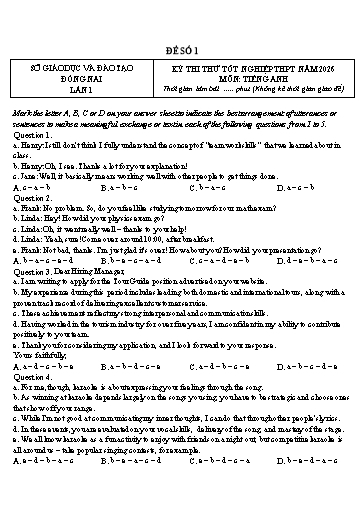
Question 1.
a. Henry: I still don't think I fully understand the concept of "teamwork skills" that we learned about in class.
b. Henry: Oh, I see. Thanks a lot for your explanation!
c. Jane: Well, it basically means working well with other people to get things done.
A. c – a – b B. a – b – c C. b – a – c D. a – c – b
Question 2.
a. Frank: No problem. So, do you feel like studying tomorrow for our math exam?
b. Linda: Hey! How did your physics exam go?
c. Linda: Oh, it went really well – thanks to your help!
d. Linda: Yeah, sure! Come over around 10:00, after breakfast.
e. Frank: Not bad, thanks. I'm just glad it's over! How about you? How did your presentation go?
A. b – a – c – e – d B. b – e – c – a – d C. c – a – d – e – b D. d – e – b – a – c
Question 3. Dear Hiring Manager,
a. I am writing to apply for the Tour Guide position advertised on your website.
b. My experience during this period includes leading both domestic and international tours, along with a proven track record of delivering excellent customer service.
c. These achievements reflect my strong interpersonal and communication skills.
d. Having worked in the tourism industry for over five years, I am confident in my ability to contribute positively to your team.
e. Thank you for considering my application, and I look forward to your response.
Yours faithfully,
A. a – d – c – b – e B. a – b – d – c – e C. a – d – b – c – e D. a – b – c – d – e
Question 4.
a. For me, though, karaoke is about expressing your feelings through the song.
b. As winning at karaoke depends largely on the songs you sing, you have to be strategic and choose ones that show off your range.
c. While I'm not good at communicating my inner thoughts, I can do that through other people's lyrics.
d. In these events, you are evaluated on your vocal skills, delivery of the song, and mastery of the stage.
e. We all know karaoke as a fun activity to enjoy with friends on a night out, but competitive karaoke is all around us – take popular singing contests, for example.
A. e – d – b – a – c B. b – e – a – c – d C. e – b – d – c – a D. b – e – d – a – c
 28 trang
31/05/2026
3290
28 trang
31/05/2026
3290
Tóm tắt nội dung tài liệu: 2 Đề thi thử tốt nghiệp THPT 2025-2026 môn Tiếng Anh SGD Đồng Nai (Có đáp án)
 ĐỀ SỐ 1
 SỞ GIÁO DỤC VÀ ĐÀO TẠO KỲ THI THỬ TỐT NGHIỆP THPT NĂM 2026
 ĐỒNG NAI MÔN: TIẾNG ANH
 LẦN 1 Thời gian làm bài: ..... phút (Không kể thời gian giao đề)
Mark the letter A, B, C or D on your answer sheet to indicate the best arrangement of utterances or
sentences to make a meaningful exchange or text in each of the following questions from 1 to 5.
Question 1.
a. Henry: I still don't think I fully understand the concept of "teamwork skills" that we learned about in
class.
b. Henry: Oh, I see. Thanks a lot for your explanation!
c. Jane: Well, it basically means working well with other people to get things done.
A. c – a – b B. a – b – c C. b – a – c D. a – c – b
Question 2.
a. Frank: No problem. So, do you feel like studying tomorrow for our math exam?
b. Linda: Hey! How did your physics exam go?
c. Linda: Oh, it went really well – thanks to your help!
d. Linda: Yeah, sure! Come over around 10:00, after breakfast.
e. Frank: Not bad, thanks. I'm just glad it's over! How about you? How did your presentation go?
A. b – a – c – e – d B. b – e – c – a – d C. c – a – d – e – b D. d – e – b – a – c
Question 3. Dear Hiring Manager,
a. I am writing to apply for the Tour Guide position advertised on your website.
b. My experience during this period includes leading both domestic and international tours, along with a
proven track record of delivering excellent customer service.
c. These achievements reflect my strong interpersonal and communication skills.
d. Having worked in the tourism industry for over five years, I am confident in my ability to contribute
positively to your team.
e. Thank you for considering my application, and I look forward to your response.
Yours faithfully,
A. a – d – c – b – e B. a – b – d – c – e C. a – d – b – c – e D. a – b – c – d – e
Question 4.
a. For me, though, karaoke is about expressing your feelings through the song.
b. As winning at karaoke depends largely on the songs you sing, you have to be strategic and choose ones
that show off your range.
c. While I'm not good at communicating my inner thoughts, I can do that through other people's lyrics.
d. In these events, you are evaluated on your vocal skills, delivery of the song, and mastery of the stage.
e. We all know karaoke as a fun activity to enjoy with friends on a night out, but competitive karaoke is
all around us – take popular singing contests, for example.
A. e – d – b – a – c B. b – e – a – c – d C. e – b – d – c – a D. b – e – d – a – c Question 5.
a. The result is devastating habitat and biodiversity loss on the island, but not all species are suffering.
b. Madagascar's forests are being converted to agricultural land at a rate of one percent every year, a shift
fueled by the cultivation of the country's main staple crop: rice.
c. There are few places in the world where relations between agriculture and conservation are more
strained.
d. A key reason for this destruction is that insect pests are destroying vast quantities of what is grown by
local subsistence farmers, leading them to clear forest to create new paddy fields.
e. In fact, some of the island's insect-eating bats are currently thriving and this has important implications
for farmers and conservationists alike.
A. c – d – b – a – e B. b – a – d – c – e C. b – d – a – c – e D. c – b – d – a – e
Read the following advertisement and mark the letter A, B, C or D on your answer sheet to indicate the
option that best fits each of the numbered blanks from 6 to 11.
 Ruthin School
Founded in 1284, Ruthin School is one of the oldest independent schools in the UK and combines a rich
history with a modern and (6) __________.
About Us
Ruthin is a selective co-educational day and boarding school, (7) __________ home to around 210
students from across the UK and more than 30 nationalities worldwide. Here at Ruthin, we offer small
class sizes and personalised teaching, while encouraging our students (8) __________ intellectual
curiosity, resilience and independence. As a result, our students (9) __________ achieve excellent results.
Why Choose Ruthin?
Ruthin School has a long tradition of academic strength, with results that place it among the strongest
small independent schools in the UK. Students progress to leading universities, (10) __________
Oxbridge and Russell Group institutions. The school maintains high academic standards but is also very
friendly and welcoming, making it well-suited to motivate students who enjoy a strong (11) __________
of community.
Question 6. A. education rigorous academically B. academically rigorous education
 C. academically education rigorous D. education academically rigorous
Question 7. A. a B. an C. the D. Ø (no article)
Question 8. A. developing B. developed C. develop D. to develop
Question 9. A. consistency B. consistent C. consistently D. consist
Question 10. A. included B. that are included C. including D. be included
Question 11. A. sense B. smell C. taste D. touch
Read the following passage and mark the letter A, B, C or D on your answer sheet to indicate the
option that best fits each of the numbered blanks from 12 to 16.
 LESSONS FROM ELON MUSK'S LIFE STORY Like that of many successful icons, (12) __________. His life story is as unpredictable as his character,
entwined with surprisingly relatable moments, and darkened by exceptionally harsh experiences.
At first glance, Elon Musk seems as if he were simply born to be amazing. However, his beginnings were
not reminiscent of a billionaire entrepreneur. His childhood bullies were not amazed by his unique vision,
(13) __________. Elon Musk wasn't born into greatness at all; he fought his way to it.
Musk's success demonstrates that sometimes success comes from learning from your failures and (14)
__________ in your abilities. His drive and perseverance are powerful reminders of how far we can truly
go when we don't let our shortcomings interfere with our goals, (15) __________, but we all have the
potential to follow our dreams and achieve so much more than we believe we are capable of.
Work, hardships, and challenges are companions in every journey to success. Faced with these obstacles
throughout his journey, Elon Musk reminds us that "When something is important enough, you do it, (16)
__________."
Question 12.
A. the birth of Elon Musk did not begin his rise to stardom
B. Elon Musk did not begin to rise to stardom at birth
C. the rise to stardom did not begin at Elon Musk's birth
D. Elon Musk's rise to stardom did not begin at birth
Question 13.
A. nor did his most groundbreaking ideas happen overnight
B. neither his most groundbreaking ideas happened overnight
C. either did his most groundbreaking ideas happen overnight
D. his most groundbreaking ideas didn't happen overnight too
Question 14.
A. strongly believing that you must always move forward
B. that you must always move forward with a strong belief
C. which always move you forward with a strong belief
D. you must always have a strong belief to move forward
Question 15.
A. On the contrary, many of us lack the natural talent or even motivation to build billion-dollar
companies
B. The natural talent or even motivation to build billion-dollar companies is possessed by quite a few of
us
C. The natural talent or even motivation to build billion-dollar companies is what none of us have
D. Granted, not all of us have the natural talent or even motivation to build billion-dollar companies
Question 16.
A. even if the odds aren't in your favor B. as if the odds aren't in your favor
C. as if your favor isn't in the odds D. even if your favor isn't in the odds
Read the following leaflet and mark the letter A, B, C or D on your answer sheet to indicate the option
that best fits each of the numbered blanks from 17 to 22. Individual Actions to Protect the Environment
While large-scale policies are essential, individuals also play a crucial role in environmental protection.
Here are some simple actions that can make a difference:
• Reduce, Reuse, Recycle: Minimize waste by opting (17) __________ reusable products and recycling
materials properly.
• Conserve Water and Energy: Switch off unnecessary lights, unplug unused electronics, and use water-
saving (18) __________ to reduce resource consumption.
• Plant Trees: Trees absorb carbon dioxide, release oxygen into the atmosphere, and provide habitats for
many species, (19) __________ supporting biodiversity.
• Participate in clean-up campaigns: Join local efforts to clean up parks, beaches, and (20) __________
public places.
Environmental protection is a shared responsibility that requires action at all levels. Thus, governments,
businesses, and individuals must join (21) __________ to reduce environmental damage. By adopting
eco-friendly habits, supporting conservation efforts, and advocating for strong environmental policies, we
can create a healthier, more (22) __________ world for future generations.
Question 17. A. on B. to C. for D. with
Question 18. A. supplies B. materials C. appliances D. accessories
Question 19. A. beside B. indeed C. thereby D. instead
Question 20. A. another B. the others C. others D. other
Question 21. A. groups B. sides C. ranks D. forces
Question 22. A. sustainable B. profitable C. available D. flexible
Read the following passage and mark the letter A, B, C or D on your answer sheet to indicate the best
answer to each of the following questions from 23 to 32.
 Getting Into the Flow
[I] The psychological concept of "flow" describes a joyful state where an individual becomes completely
immersed in a challenging but manageable activity. [II] First developed by Hungarian psychologist
Mihaly Csikszentmihalyi, the concept was initially based on observations of artists who displayed intense
focus during their creative work. [III] Ultimately, experiencing flow in leisure and professional pursuits
significantly enhances positive emotions, overall performance, and commitment to meaningful long-term
goals. [IV]
 Achieving flow requires specific conditions, primarily characterized by a complete loss of
reflective self-consciousness. The activity must be voluntary, intrinsically motivating, and must provide
clear goals with immediate feedback. Csikszentmihalyi identified six main factors of flow, including
intense concentration on the present moment, a strong sense of personal control, and a distorted
perception of time. Regularly experiencing these elements correlates strongly with increased
psychological well-being, higher self-esteem, and improved concentration.
 To scientifically measure this optimal state, Csikszentmihalyi and Robert Larson developed the
experience sampling method (ESM). Subjects received random beeper alerts prompting them to
immediately record their current activities and emotional states. Over time, this data revealed distinct behavioral patterns regarding human happiness. Notably, results demonstrated that individuals reported
higher happiness levels after participating in active hobbies or social events compared to passive
activities like watching television.
Studies focusing on teenagers highlight significant differences between "high-flow" and "low-flow"
individuals. High-flow teenagers spend considerably more time on active leisure, resulting in higher self-
esteem, better social relationships, and greater academic success. Conversely, a preference for low-flow
activities like television can unfortunately contribute to lower self-esteem and depression. Despite the
immense long-term benefits, people habitually choose low-flow activities because achieving flow
requires much more initial motivation, mental effort, and skill.
Recent research demonstrates that the benefits of flow extend globally, with similar findings replicated in
countries like Italy and India. Beyond youth studies, modern psychology has expanded flow applications
into professional and educational environments. In workplaces, balancing enjoyment, interest, and
absorption dramatically increases employee productivity, creativity, and overall well-being.
Similarly, educators who frequently experience flow are better able to draw on their personal resources,
ultimately creating much richer learning environments for their students.
Question 23. Where in paragraph 1 does the following sentence best fit?
These individuals often lost track of time and ignored basic needs like food or sleep while working.
A. [IV] B. [III] C. [I] D. [II]
Question 24. The reference to artists in paragraph 1 primarily serves to __________.
A. provide an early example of a characteristic associated with flow
B. argue that flow is most commonly found in creative professions
C. explain the research method Csikszentmihalyi used to study flow
D. illustrate that flow is psychologically challenging but manageable
Question 25. According to paragraph 2, which of the following is NOT a characteristic or condition of
flow?
A. A strong sense of personal control over the task
B. Immediate feedback on the individual's progress
C. A less than accurate idea about the passage of time
D. A high level of physical strength and endurance
Question 26. The word "optimal" in paragraph 3 is CLOSEST in meaning to __________.
A. ideal B. positive C. suitable D. typical
Question 27. The word "them" in paragraph 3 refers to __________.
A. alerts B. subjects C. activities D. states
Question 28. Which of the following best summarizes paragraph 4?
A. High-flow activities require significant mental effort, making them less popular among teenagers than
low-flow activities.
B. Teenagers generally prefer passive activities like watching television despite the negative impacts on
their mental health.
C. While high-flow activities demand initial effort, they yield far better psychological and academic
outcomes for teenagers. D. Low-flow activities are directly responsible for the increasing rates of depression and low self-esteem
among teenagers.
Question 29. Which of the following best paraphrases the underlined sentence in paragraph 5?
In workplaces, balancing enjoyment, interest, and absorption dramatically increases employee
productivity, creativity, and overall well-being.
A. Achieving a combination of enjoyment, interest, and deep engagement at work significantly enhances
workers' output and health.
B. Engaged employees who find their work enjoyable and interesting are more likely to experience
greater workplace well-being.
C. Only by independently improving overall productivity and creativity can employees actually achieve
enjoyment and absorption.
D. Balancing enjoyment, interest, and absorption at work requires creative employees to improve their
productivity and well-being.
Question 30. Which of the following is TRUE according to the passage?
A. Evidence for the benefits of flow remains largely limited to artistic settings and adolescent
populations.
B. Many still prefer low-flow activities since they require less effort and motivation at the outset.
C. The ESM relied mainly on participants' later reflections on how they had felt during the day.
D. Experiencing flow at work tends to raise productivity at the cost of creativity and well-being.
Question 31. Which of the following can be inferred from the passage?
A. Passive leisure is less beneficial than active leisure, but schools should not try to reduce it.
B. Flow depends more on task difficulty than on motivation, goals, or feedback.
C. Creating conditions that support flow could be an effective strategy for educational institutions.
D. Because flow is more common in artists, this group stands to benefit more from it than others do.
Question 32. Which of the following best summarizes the passage?
A. The concept of flow, initially discovered by observing artists, has now become an essential
psychological framework for explaining why individuals prefer passive entertainment.
B. Extensive research by psychologist Mihaly Csikszentmihalyi demonstrates that engaging in
challenging tasks directly promises academic success and wealth for global citizens.
C. Low-flow activities like watching television are widely popular and ultimately lead to higher self-
esteem compared to high-flow activities that demand advanced skills.
D. A deeply absorbing psychological state that supports well-being and performance across many fields
of human endeavor, flow usually requires active engagement.
Read the following passage and mark the letter A, B, C or D on your answer sheet to indicate the best
answer to each of the following questions from 33 to 40.
Huge Drop in African Elephants
 African elephants are Earth's largest land animals. They are very intelligent and highly social
creatures. A recent study, however, reveals that populations of African elephants have sharply decreased
over the past fifty years. The researchers described their work as the most comprehensive study of the two African elephant
species – the savanna elephant and forest elephant. Using data gathered at 475 areas in 37 countries from
1964 through 2016, the study found that savanna elephant populations fell by about 70 percent on average
and forest elephant populations dropped by about 90 percent on average. The researchers mainly
attributed the decline to illegal hunting and the loss of the animals' natural habitat.
 The illegal hunting and killing of elephants for their tusks continues unabated, as poachers profit
heavily from the black-market ivory trade, particularly in China and other parts of Asia, where demand
for this commodity remains strong. Poaching has taken a toll on forest elephants – whose population is
estimated to be about one-third that of savanna elephants – with the damage being especially acute in
northern and eastern Africa, including Mali, Chad, and Nigeria.
 The study also identified agricultural expansion as a major cause of habitat loss, with more and
more natural land being cleared for farming and human settlement. This growing pressure further
threatens elephant populations that are already weakened by poaching. George Wittemyer, a
Colorado State University professor and researcher with Save the Elephants who helped lead the study,
warned that many lost populations are unlikely to return, while others that survive in low numbers
continue to face serious risks. The study, published in the Proceedings of the National Academy of
Sciences, suggests that further population losses are likely in the future.
Question 33. Which of the following is NOT mentioned as a cause of the decline in African elephant
populations?
A. illegal hunting B. climate change C. agricultural expansion D. habitat loss
Question 34. The word "attributed" in paragraph 2 most nearly means __________.
A. showed B. proved C. linked D. caused
Question 35. The phrase "this commodity" in paragraph 3 refers to __________.
A. black market B. poaching C. ivory D. trade
Question 36. The word "acute" in paragraph 3 is OPPOSITE in meaning to __________.
A. mild B. brief C. noticeable D. significant
Question 37. Which of the following best paraphrases the underlined sentence in paragraph 4?
This growing pressure further threatens elephant populations that are already weakened by
poaching.
A. Poaching has reduced elephant numbers, and continued habitat loss is forcing the survivors into human
settlements.
B. Ongoing destruction of elephant habitat puts additional strain on populations already severely affected
by poaching.
C. The expansion of agriculture and human settlement, along with poaching, continues to threaten
elephant populations.
D. The loss of habitat is encouraging more poaching, which is placing increasing pressure on elephant
populations.
Question 38. Which of the following is TRUE according to the passage?
A. The expansion of agriculture is a major cause of elephant habitat loss.
B. The ivory trade is legal in most Asian markets. C. Savanna elephant populations declined by about 90 percent on average.
D. Forest elephants now outnumber savanna elephants in many parts of Africa.
Question 39. In which paragraph does the writer mention statistical evidence from research?
A. Paragraph 4 B. Paragraph 2 C. Paragraph 3 D. Paragraph 1
Question 40. In which paragraph does the writer discuss possible future consequences for elephants?
A. Paragraph 2 B. Paragraph 4 C. Paragraph 1 D. Paragraph 3
 ------------------ THE END ------------------ ĐÁP ÁN THAM KHẢO
 1. D 2. B 3. C 4. A 5. D 6. B 7. D 8. D 9. C 10. C
 11. A 12. D 13. A 14. A 15.D 16. A 17. C 18. C 19. C 20. D
 21. D 22. A 23. B 24. A 25. D 26. A 27. B 28. C 29. A 30. B
 31. C 32. D 33. B 34. C 35. C 36. A 37. B 38. A 39. B 40. B
 LỜI GIẢI THAM KHẢO
Câu 1
Đáp án: D (a – c – b)
- a: Henry nói chưa hiểu khái niệm “teamwork skills”.
- c: Jane giải thích khái niệm đó.
- b: Henry sau khi nghe giải thích thì nói “Oh, I see. Thanks...”.
Trình tự hợp lí là: nêu thắc mắc → giải thích → cảm ơn.
Câu 2
Đáp án: B (b – e – c – a – d)
- b: Linda hỏi Frank bài thi vật lí thế nào.
- e: Frank trả lời rồi hỏi ngược lại Linda về bài thuyết trình.
- c: Linda trả lời bài thuyết trình tốt nhờ Frank giúp.
- a: Frank nói “No problem” rồi rủ học toán hôm sau.
- d: Linda đồng ý và hẹn giờ.
Chuỗi hội thoại đúng là hỏi → đáp + hỏi lại → đáp → rủ → đồng ý.
Câu 3
Đáp án: C (a – d – b – c – e)
Đây là thư xin việc.
- a: Mở đầu, nêu mục đích viết thư xin vị trí Tour Guide.
- d: Nêu kinh nghiệm hơn 5 năm và sự tự tin.
- b: Triển khai cụ thể kinh nghiệm dẫn tour và chăm sóc khách hàng.
- c: Tổng kết rằng những thành tựu đó thể hiện kĩ năng giao tiếp, ứng xử.
- e: Câu kết thư lịch sự.
Trình tự đúng của thư xin việc là mở thư → khái quát năng lực → chi tiết kinh nghiệm → rút ra
điểm mạnh → kết thư.
Câu 4
Đáp án: A (e – d – b – a – c)
- e: Mở đoạn, giới thiệu karaoke thông thường và karaoke thi đấu.
- d: “In these events” phải chỉ popular singing contests ở câu e.
- b: Nói tiếp về việc muốn thắng thì phải chọn bài chiến lược.
- a: “For me, though” chuyển sang quan điểm cá nhân.
- c: Giải thích thêm cho ý a: dù không giỏi nói ra suy nghĩ, người nói làm điều đó qua lời bài hát.
Mạch logic: giới thiệu cuộc thi → tiêu chí đánh giá → chiến lược thi → quan điểm cá nhân → giải
thích thêm. Câu 5
Đáp án: D (c – b – d – a – e)
- c: Câu chủ đề, nêu quan hệ căng thẳng giữa nông nghiệp và bảo tồn.
- b: Cụ thể hóa bằng việc rừng Madagascar bị chuyển thành đất nông nghiệp.
- d: Giải thích nguyên nhân của sự tàn phá đó.
- a: Nêu kết quả: mất nơi sống và đa dạng sinh học.
- e: “In fact” bổ sung ý ngược lại: không phải loài nào cũng đang suy giảm, một số loài dơi còn phát triển.
Mạch đoạn văn: nêu vấn đề → thực trạng → nguyên nhân → hậu quả → ngoại lệ đáng chú ý.
Câu 6
Đáp án: B. academically rigorous education
Câu gốc: “... combines a rich history with a modern and (6) ______.”
Sau “a modern and” cần một cụm danh từ để song song với “a rich history”.
→ academically rigorous education = một nền giáo dục nghiêm túc, chất lượng cao về học thuật.
Các phương án khác sai trật tự từ.
Câu 7
Đáp án: D. Ø (no article)
Câu: “Ruthin is a selective co-educational day and boarding school, (7) ______ home to around 210
students...”
Cụm cố định: be home to = là nơi có, là mái nhà của. Ở đây không cần mạo từ: home to around 210
students.
Câu 8
Đáp án: D. to develop
Cấu trúc: encourage somebody to do something
→ “encouraging our students to develop intellectual curiosity...”
Câu 9
Đáp án: C. consistently
Câu: “As a result, our students (9) ______ achieve excellent results.”
→ Cần một trạng từ bổ nghĩa cho động từ “achieve”.
→ consistently achieve = luôn luôn đạt được.
Câu 10
Đáp án: C. including
Câu: “Students progress to leading universities, (10) ______ Oxbridge and Russell Group institutions.”
Sau dấu phẩy, cần từ mang nghĩa “bao gồm”. including là đúng.
Câu 11
Đáp án: A. sense
Cụm cố định: a sense of community = tinh thần/cảm giác gắn kết cộng đồng.
Câu 12
Đáp án: D. Elon Musk's rise to stardom did not begin at birth
Câu: “Like that of many successful icons, (12) ______.”
File đính kèm:
- 2_de_thi_thu_tot_nghiep_thpt_2025_2026_mon_tieng_anh_sgd_don.docx

