

2 Đề thi thử tốt nghiệp THPT 2026 môn Tiếng Anh SGD Phú Thọ (Có đáp án)
Question 1: A. invested B. saved C. borrowed D. wasted
Question 2: A. much B. every C. many D. little
Question 3: A. in B. of C. at D. with
Question 4: A. While B. However C. Although D. Because
Question 5:
A. vehicle makers electric B. makers vehicle electric
C. electric vehicle makers D. makers electric vehicle
Question 6: A. complete B. total C. full D. whole
 33 trang
04/06/2026
3750
33 trang
04/06/2026
3750
Bạn đang xem 30 trang mẫu của tài liệu "2 Đề thi thử tốt nghiệp THPT 2026 môn Tiếng Anh SGD Phú Thọ (Có đáp án)", để tải tài liệu gốc về máy hãy click vào nút Download ở trên.
Tóm tắt nội dung tài liệu: 2 Đề thi thử tốt nghiệp THPT 2026 môn Tiếng Anh SGD Phú Thọ (Có đáp án)
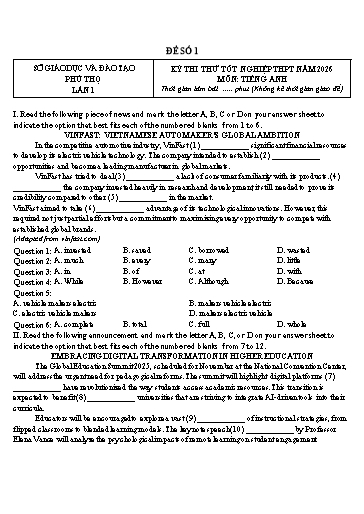
 ĐỀ SỐ 1
 SỞ GIÁO DỤC VÀ ĐÀO TẠO KỲ THI THỬ TỐT NGHIỆP THPT NĂM 2026
 PHÚ THỌ MÔN: TIẾNG ANH
 LẦN 1 Thời gian làm bài: ..... phút (Không kể thời gian giao đề)
I. Read the following piece of news and mark the letter A, B, C or D on your answer sheet to
indicate the option that best fits each of the numbered blanks from 1 to 6.
 VINFAST: VIETNAMESE AUTOMAKER'S GLOBAL AMBITION
 In the competitive automotive industry, VinFast (1) ____________ significant financial resources
to develop its electric vehicle technology. The company intended to establish (2) ____________
opportunities and become a leading manufacturer in global markets.
 VinFast has tried to deal (3) ____________ a lack of consumer familiarity with its products. (4)
____________ the company invested heavily in research and development, it still needed to prove its
credibility compared to other (5) ____________ in the market.
VinFast aimed to take (6) ____________ advantage of its technological innovations. However, this
required not just partial efforts but a commitment to maximizing every opportunity to compete with
established global brands.
(Adapted from vinfast.com)
Question 1: A. invested B. saved C. borrowed D. wasted
Question 2: A. much B. every C. many D. little
Question 3: A. in B. of C. at D. with
Question 4: A. While B. However C. Although D. Because
Question 5:
A. vehicle makers electric B. makers vehicle electric
C. electric vehicle makers D. makers electric vehicle
Question 6: A. complete B. total C. full D. whole
II. Read the following announcement and mark the letter A, B, C, or D on your answer sheet to
indicate the option that best fits each of the numbered blanks from 7 to 12.
 EMBRACING DIGITAL TRANSFORMATION IN HIGHER EDUCATION
 The Global Education Summit 2025, scheduled for November at the National Convention Center,
will address the urgent need for pedagogical reforms. The summit will highlight digital platforms (7)
____________ have revolutionized the way students access academic resources. This transition is
expected to benefit (8) ____________ universities that are striving to integrate AI-driven tools into their
curricula.
 Educators will be encouraged to explore a vast (9) ____________ of instructional strategies, from
flipped classrooms to blended learning models. The keynote speech (10) ____________ by Professor
Elena Vance will analyze the psychological impacts of remote learning on student engagement. This event is a golden opportunity for academics, school administrators, and tech developers to
exchange ideas and foster (11) ____________. We strongly advise interested parties to (12)
____________ the workshops in advance to guarantee participation in these high-demand sessions.
 For more information, please visit https://edusummit2025.edu
Question 7: A. whom B. whose C. who D. which
Question 8: A. initial B. superior C. primary D. leading
Question 9: A. deal B. number C. amount D. level
Question 10: A. delivering B. delivers C. is delivered D. delivered
Question 11: A. innovatively B. innovation C. innovate D. innovative
Question 12: A. register for B. account for C. apply for D. look for
 (Adapted from https://edusummit2025.edu)
III. Mark the letter A, B, C, or D on your answer sheet to indicate the best arrangement of
utterances or sentences to make a meaningful exchange or text in each of the following items from
questions 13 to 17.
Question 13:
a. Anna: I just heard APT on Youtube, and it made my day!
b. Anna: Exactly! Music has such a powerful way of lifting our spirits.
c. Ben: That’s awesome! I love that song too; it always puts me in a good mood.
A. a – c – b B. a – b – c C. b – a – c D. c – b – a
Question 14:
a. Furthermore, the high cost of living in cities often forces people to work longer hours, leading to a poor
work-life balance.
b. In conclusion, while urban areas offer numerous opportunities, the associated social and financial
pressures cannot be ignored.
c. However, this rapid growth brings about significant challenges, such as housing shortages and
increased pollution levels.
d. Urbanization has become a global phenomenon, with more people moving to cities in search of better
job prospects and modern amenities.
e. Consequently, many urban residents struggle to find affordable accommodation near their workplaces,
resulting in long daily commutes.
A. d – c – e – a – b B. d – a – c – e – b C. c – d – e – a – b D. d – c – a – e – b
Question 15:
a. Traditional gatherings such as family dinners and neighborhood events have long provided
opportunities for people to strengthen their interpersonal bonds.
b. However, the widespread adoption of social networking sites has significantly expanded the ways in
which individuals can initiate and nurture relationships.
c. Social interaction patterns have changed dramatically in recent decades as digital communication tools
have become ubiquitous worldwide. d. This shift has prompted researchers to investigate whether online friendships offer the same
psychological benefits as those formed through physical proximity.
e. Consequently, many experts now suggest maintaining a healthy balance between virtual connections
and real-world social engagements for optimal well-being.
A. a – c – b – e – d B. c – a – b – d – e C. c – b – a – d – e D. c – a – d – b – e
Question 16:
Dear Valued Residents,
a. Therefore, we kindly request all households to separate their organic waste from recyclable materials
starting next Monday.
b. We are writing to inform you about our new "Green Community" initiative aimed at reducing the
neighborhood's carbon footprint.
c. For further details on the new collection schedule, please refer to the pamphlet attached to this notice.
d. We believe that through these small collective actions, we can significantly improve the local
environment for our children.
e. In addition, special bins for plastic and glass will be placed at the end of each street to facilitate this
process. Yours sincerely,
The Residents' Committee
A. b – e – a – d – c B. b – a – e – d – c C. a – b – e – d – c D. b – a – e – c – d
Question 17:
a. Anna: Me too! Did you try the new coffee shop on Main Street?
b. Anna: I love spending weekends exploring new places.
c. Ben: Yes, their latte was amazing. We should go there together sometime.
d. Ben: Absolutely! How about next Saturday?
e. Anna: That sounds perfect!
A. b – a – c – d – e B. a – c – b – e – d C. b – c – a – e – d D. a – b – d – c – e
IV. Read the following passage and mark the letter A, B, C or D on your answer sheet to indicate
the option that best fits each of the numbered blanks from 18 to 22.
 REGENERATIVE AGRICULTURE AND ECO-SYSTEM RESTORATION
 The global movement toward regenerative agriculture is a big change in how we take care of our
natural environment. This farming method focuses on enhancing soil health and promoting biodiversity,
(18) ____________. When farmers eliminate their reliance on chemical fertilizers, they can help the soil
take in more carbon, which is crucial for mitigating the adverse effects of climate change.
However, starting these greener farming methods is often hard because of money problems. Small
farmers, who have to pay high costs and get very little help from the government, (19) ____________
rather than adopting long-term sustainable models. This economic pressure prevents many farmers from
making the essential transition to organic methods. (20) ____________. If governments don't give more
financial support, the gap between environmental goals and farming reality will continue to widen.
 Furthermore, success in nature restoration depends on a mix of local knowledge, community
engagement, and (21) ____________. These elements must work together to ensure that conservation efforts are effective and fit the local culture. While some regions have witnessed a great recovery of
native flora, others still struggle with land quality. (22) ____________, particularly when local
communities are empowered to manage their own resources through innovative land-use agreements.
Question 18:
A. where these practices are considered essential for agricultural results
B. these methods ensure food output rather than global food security
C. every method improves food output but is not essential for global security
D. all of which are considered essential for global food security
Question 19:
A. traditional habits are frequently maintained by farmers to maximize profits.
B. has frequently kept traditional habits despite environmental concerns
C. frequently maintaining traditional habits to maximize profits for local residents and authority
D. frequently choose to maintain traditional habits despite negative environmental impact
Question 20:
A. Insufficient funding remains a major barrier to achieving system changes
B. Adequate funding still serves as a significant barrier to genuine system changes
C. Minimal funding effectively eliminates every barrier to system changes
D. Abundant funding provides a temporary barrier for agricultural system changes
Question 21:
A. on account of using modern technology to monitor and check the health of ecosystems carefully
B. thanks to applying modern technological solutions for environmental monitoring and resource
integration
C. the use of modern technology that can harm traditional farming practices in many ways
D. the integration of modern technology that can enhance monitoring and resource management
Question 22:
A. Indeed, promising outcomes emerge in areas where scientific research is combined with indigenous
practices
B. Similarly, negative outcomes always emerge when scientific research ignores indigenous knowledge
completely
C. By contrast, promising outcomes emerge where indigenous practices replace scientific research
entirely
D. Financial obstacles prevent a wide range of positive outcomes despite scientific research and local
efforts, for example
V. Read the passage and mark the letter A, B, C or D on your answer sheet to indicate the best
answer to each of the following questions from 23 to 30.
 In the scorching heat of Mandalay, hundreds of patients – from infants to the elderly and Buddhist
monks – are lying on hospital beds in an outdoor car park. Three days after a catastrophic earthquake hit
Myanmar, the people in the city are very worried and waiting for more shaking. Despite having approximately 1,000 beds, Mandalay General Hospital has relocated most patients
outside following the devastating earthquake that claimed over 2,000 lives across Myanmar and Thailand.
The 7.7-magnitude tremor on March 28, accompanied by numerous aftershocks, has forced authorities to
keep patients outdoors to prevent potential injuries from collapsing structures. The situation is far from
ideal for anyone here at the hospital. "We're doing everything possible under these circumstances," an
anonymous medical worker explained to AFP.
 With temperatures reaching 39 degrees Celsius, patients found shelter beneath makeshift tarpaulin
covers erected to protect them from the intense sun. Family members held their relatives' hands, offering
reassurance, while others used bamboo fans to provide relief. Young children with injuries cried in the
uncomfortable environment, and a wounded monk lay connected to an intravenous drip.
 Medical staff are equally affected by the crisis. During brief breaks from their grueling work
schedules, healthcare workers sat on the ground, attempting to regain their strength. While the hospital
structure appeared intact, only critical care patients and their attending physicians stayed indoors.
Everyone else crowded together under the tarpaulin or found shelter in a nearby area with a metal roof.
Question 23: The word “scorching” in paragraph 1 could be best replaced by ____________.
A. cool B. boiling C. freezing D. mild
Question 24: Which of the following best paraphrases the underlined sentence in paragraph 2?
The situation is far from ideal for anyone here at the hospital.
A. Everything at this healthcare center is completely unacceptable and intolerable for every single person.
B. The current conditions at the medical facility are extremely challenging for all people present.
C. The environment in the outdoor area remains quite uncomfortable for patients and their families.
D. The present circumstances at Mandalay hospital are somewhat difficult for most individuals there.
Question 25: The word “them” in paragraph 3 refers to ____________.
A. tarpaulin covers B. patients C. family members D. temperatures
Question 26: The word “grueling” in paragraph 4 is OPPOSITE in meaning to ____________.
A. effortless B. exhausting C. tiring D. demanding
Question 27: In paragraph 4, which group of people is NOT mentioned as being present at the hospital
during the crisis?
A. medical staff B. critical care patients C. family members D. attending physicians
Question 28: According to the passage, which of the following statements is TRUE?
A. The hospital's 1,000-bed capacity was adequate to accommodate all patients indoors during the crisis.
B. Authorities moved patients outside primarily because of the extreme heat reaching 39 degrees Celsius.
C. The hospital building suffered severe structural damage requiring complete evacuation of the facility.
D. The 7.7-magnitude earthquake on March 28 killed over 2,000 people in Myanmar and Thailand.
Question 29: In which paragraph does the writer describe how medical staff coped during breaks?
A. Paragraph 1 B. Paragraph 4 C. Paragraph 2 D. Paragraph 3
Question 30: In which paragraph does the writer mention the protective measures taken against the sun?
A. Paragraph 3 B. Paragraph 1 C. Paragraph 4 D. Paragraph 2 VI. Read the passage and mark the letter A, B, C or D on your answer sheet to indicate the best
answer to each of the following questions from 31 to 40.
 For decades, the SAT has functioned as a main door to higher education in the United States,
shaping admissions outcomes and perceptions of academic potential. Originally conceived to measure
ability, the test once symbolized fair opportunity. Yet, in recent years, its fairness and relevance have
come under examination, prompting debate about whether standardized testing can represent the complex
intelligence of contemporary learners. [I] As education evolves, the SAT finds itself caught between
tradition and the demand for comprehensive methods of student readiness.
 The College Board's decision to transition the SAT to a fully digital format marks a significant
turning point. The new SAT, shorter in duration and adaptive in structure, seeks to evaluate reasoning skills
with precision and accessibility. Students now complete the exam on laptops or tablets, receiving results
within days rather than weeks. [II] This digital transformation extends beyond logistical convenience; it
mirrors the broader reconfiguration of education in the post- pandemic era, where technology has become
inseparable from learning and assessment. Still, one question remains: can an algorithm truly capture the
depth of critical thinking?
 Equity remains the SAT's most persistent challenge. Critics argue that the exam continues economic
and social inequalities, as students from affluent backgrounds often have access to private tutoring and
extensive preparation programs that enhance their scores. By contrast, students from under-resourced
communities frequently lack comparable support. Although the College Board has expanded fee waivers
and developed free online practice tools through initiatives such as its partnership with Khan Academy,
these measures only partially reduce systematic unfairness. [III] The test operates within a system where
the playing field is far from level, and genuine potential may be obscured by unequal access to educational
resources.
 As an increasing number of universities adopt test-optional or test-blind admissions policies, the
SAT faces a critical turning point. Proponents argue that standardized assessments remain necessary for
maintaining objectivity, particularly amid grade inflation and different curricular standards across
schools. [IV] The future of academic evaluation may thus lie in balance ___ where quantitative measures
coexist with comprehensive approaches that value creativity, resilience, and lived experience alongside
intellectual performance. Whether the SAT endures or diminishes in influence, one principle remains
clear: education must evolve not to measure conformity, but to open doors to possibility.
Question 31: The word "itself" in paragraph 1 refers to ____________.
A. tradition B. education C. the SAT D. the demand
Question 32: Which of the following is NOT mentioned as a characteristic of the new digital SAT?
A. it provides results within a few days. B. It is shorter in duration
C. It is completed on electronic devices. D. It includes a mandatory essay section.
Question 33: Which of the following best summarises paragraph 1?
A. The SAT's historical role as a symbol of fair opportunity is being challenged by its shift to a digital
format. B. The SAT's evolution is primarily driven by the need to balance tradition with comprehensive methods
of student potential.
C. The SAT, once a respected measure of ability, is now facing scrutiny regarding its fairness and ability
to assess modern learners.
D. Debates about the SAT's relevance have led to calls for more traditional methods of evaluating student
readiness.
Question 34: The word “reconfiguration” in paragraph 2 is CLOSEST in meaning to ____________.
A. stability B. reorganization C. removal D. reduction
Question 35: According to paragraph 2, what specific changes have been made to the new SAT?
A. The exam now focuses on memorization rather than evaluating the students' reasoning skills.
B. The exam provides results within weeks instead of days for all digital participants.
C. The exam now requires less time and employs a personalized framework tailored to test-takers
D. The exam is much longer and requires students to use paper-based answer sheets.
Question 36: Which of the following best paraphrases the underlined sentence in paragraph 4?
A. Education will only truly evolve if it focuses on standardizing learning outcomes to open more doors
for students.
B. For education to progress, it must prioritize the measurement of students' ability to conform over their
potential for innovation.
C. Education's primary goal should be to ensure students adhere to established norms rather than explore
new avenues.
D. The purpose of education is to adapt and create opportunities, not merely to assess how well
individuals fit predefined standards.
Question 37: What can be inferred from the passage?
A. The SAT is no longer administered or required by most higher education institutions
B. Grade inflation and varied curricula have no effect on university admissions outcomes
C. Standardized tests alone may not fully capture students' intellectual potential
D. Using digital technology automatically enhances adolescents' critical thinking abilities
Question 38: The mention of "grade inflation and different curricular standards across schools" in
paragraph 4 serves to ____________.
A. explain why standardized tests are considered necessary by some for objectivity.
B. advocate for a universal curriculum to ensure fairness in grading.
C. criticize the declining academic standard in modern high schools.
D. illustrate the challenges faced by students in diverse educational systems.
Question 39: Where in the passage does the following sentence best fit?
Opponents, however, maintain that human potential cannot be reduced to a numerical value.
A. [I] B. [IV] C. [III] D. [II]
Question 40: Which of the following best summarises the main idea of the passage?
A. The primary challenge for the SAT is adapting its assessment methods to accurately measure critical
thinking skills in an increasingly digital learning environment. B. The SAT's transition to a digital format has successfully resolved its long-standing issues concerning
fairness and relevance in higher education.
C. Despite its historical role, the SAT is currently undergoing significant scrutiny regarding its fairness
and relevance, prompting a shift towards more comprehensive evaluation methods in higher education.
D. The College Board's efforts to provide equitable access to SAT preparation have largely mitigated the
socioeconomic disparities associated with the exam.
 ----------------THE END----------------
 ĐÁP ÁN
I. Read the following piece of news and mark the letter A, B, C or D on your answer sheet to
indicate the option that best fits each of the numbered blanks from 1 to 6.
Question 1: A.
A. invested - ĐÚNG: Cụm từ "invest resources" nghĩa là đầu tư nguồn lực. Hợp ngữ cảnh VinFast bỏ
tiền để phát triển công nghệ.
B. saved - SAI: "Saved" (tiết kiệm) không phù hợp với ngữ cảnh phát triển công nghệ mới cần chi tiêu
lớn.
C. borrowed - SAI: "Borrowed" (vay mượn) không đi kèm với "resources" theo nghĩa phát triển nội tại
trong ngữ cảnh này.
D. wasted - SAI: "Wasted" (lãng phí) mang nghĩa tiêu cực, trái với ý định phát triển của công ty.
Question 2: C.
A. much - SAI: "Much" dùng cho danh từ không đếm được. "Opportunities" là danh từ đếm được số
nhiều.
B. every - SAI: "Every" dùng cho danh từ số ít.
C. many - ĐÚNG: "Many" dùng cho danh từ đếm được số nhiều (opportunities).
D. little - SAI: "Little" dùng cho danh từ không đếm được.
Question 3: D.
A. in - SAI: Không đi với "deal" trong ngữ cảnh này.
B. of - SAI: Không phù hợp.
C. at - SAI: Không phù hợp.
D. with - ĐÚNG: Cụm động từ "deal with" nghĩa là giải quyết, xử lý (vấn đề thiếu sự quen thuộc của
người dùng).
Question 4: C.
A. While - SAI: Dù "While" có thể chỉ sự nhượng bộ, nhưng trong cấu trúc câu này, "Although" phổ
biến và trang trọng hơn khi đứng đầu mệnh đề nhượng bộ trực tiếp.
B. However - SAI: "However" là trạng từ liên kết, thường đứng sau dấu chấm hoặc dấu chấm phẩy,
không dùng để nối mệnh đề trạng ngữ chỉ sự nhượng bộ ngay đầu câu như "Although".
C. Although - ĐÚNG: Liên từ chỉ sự nhượng bộ "Mặc dù... nhưng vẫn...". (Mặc dù đầu tư mạnh, nhưng
vẫn cần chứng minh uy tín).
D. Because - SAI: Liên từ chỉ nguyên nhân, làm sai logic câu (Không phải vì đầu tư mạnh nên mới cần
chứng minh uy tín). Question 5: C.
A, B, D - SAI: Sai trật tự từ của cụm danh từ ghép.
C. electric vehicle makers - ĐÚNG: Trật tự chuẩn: Loại năng lượng (Electric) + Loại phương tiện
(Vehicle) + Danh từ chính (Makers) -->Các nhà sản xuất xe điện.
Question 6: C. full
A. complete - SAI: Không tạo thành cụm cố định phổ biến với "advantage".
B. total - SAI: Tương tự.
C. full - ĐÚNG: Cụm cố định "take full advantage of" nghĩa là tận dụng tối đa/triệt để.
D. whole - SAI: Không dùng trong cụm từ này.
*Dịch
 VINFAST: THAM VỌNG TOÀN CẦU CỦA HÃNG XE VIỆT NAM
 Trong ngành công nghiệp ô tô đầy tính cạnh tranh, VinFast đã đầu tư nguồn lực tài chính đáng kể
để phát triển công nghệ xe điện của mình. Công ty đặt mục tiêu tạo ra nhiều cơ hội và trở thành một nhà
sản xuất hàng đầu trên các thị trường toàn cầu.
 VinFast đã nỗ lực giải quyết với tình trạng người tiêu dùng còn thiếu sự quen thuộc với các sản
phẩm của mình. Mặc dù công ty đầu tư mạnh vào nghiên cứu và phát triển, nhưng vẫn cần chứng minh
độ tin cậy của mình so với các nhà sản xuất xe điện khác trên thị trường.
VinFast hướng tới việc tận dụng tối đa lợi thế từ những đổi mới công nghệ của mình. Tuy nhiên, điều
này đòi hỏi không chỉ những nỗ lực một phần mà còn là sự cam kết trong việc khai thác triệt để mọi cơ
hội để cạnh tranh với các thương hiệu toàn cầu đã được khẳng định.
II. Read the following announcement and mark the letter A, B, C, or D on your answer sheet to
indicate the option that best fits each of the numbered blanks from 7 to 12.
Question 7: D.
A. whom - SAI: Dùng thay thế cho người (tân ngữ).
B. whose - SAI: Chỉ sự sở hữu.
C. who - SAI: Dùng thay thế cho người (chủ ngữ).
D. which - ĐÚNG: Đại từ quan hệ thay thế cho vật/sự vật (digital platforms) làm chủ ngữ trong mệnh đề
quan hệ.
Question 8: D.
 A. initial - SAI: Nghĩa là "ban đầu", không hợp ngữ cảnh các trường đại học tiên phong.
B. superior - SAI: Nghĩa là "cao cấp hơn", thường dùng trong so sánh.
C. primary - SAI: Nghĩa là "chính/cơ bản".
D. leading - ĐÚNG: "Leading universities" nghĩa là các trường đại học hàng đầu/tiên phong.
Question 9: B.
A. deal - SAI: "A great deal of" đi với danh từ không đếm được. "Strategies" là đếm được số nhiều.
B. number - ĐÚNG: "A vast number of" đi với danh từ đếm được số nhiều (strategies).
C. amount - SAI: Đi với danh từ không đếm được.
D. level - SAI: Nghĩa là "mức độ", không chỉ số lượng.
Question 10: D.
A, B, C - SAI: Sai ngữ pháp. Câu đã có động từ chính "will analyze". Cần rút gọn mệnh đề quan hệ. D. delivered - ĐÚNG: Rút gọn mệnh đề quan hệ dạng bị động (Which is delivered -->delivered). Bài
phát biểu được trình bày bởi Giáo sư Elena.
Question 11: B.
A. innovatively - SAI: Trạng từ.
B. innovation - ĐÚNG: Cần một danh từ làm tân ngữ cho động từ "foster" (thúc đẩy sự đổi mới).
C. innovate - SAI: Động từ.
D. innovative - SAI: Tính từ.
Question 12: A.
A. register for - ĐÚNG: Cụm động từ "register for" nghĩa là đăng ký tham gia (hội thảo).
B. account for - SAI: Nghĩa là chiếm bao nhiêu % hoặc giải thích lý do.
C. apply for - SAI: Thường dùng cho xin việc, xin học bổng (nộp đơn).
D. look for - SAI: Nghĩa là tìm kiếm.
*Dịch
 ĐÓN NHẬN CHUYỂN ĐỔI SỐ TRONG GIÁO DỤC ĐẠI HỌC
 Hội nghị Thượng đỉnh Giáo dục Toàn cầu 2025, dự kiến tổ chức vào tháng 11 tại Trung tâm Hội
nghị Quốc gia, sẽ tập trung giải quyết nhu cầu cấp thiết về cải cách phương pháp giảng dạy. Hội nghị sẽ
nhấn mạnh các nền tảng số đã cách mạng hóa cách thức sinh viên tiếp cận các nguồn tài nguyên học
thuật. Sự chuyển đổi này được kỳ vọng sẽ mang lại lợi ích cho các trường đại học hàng đầu đang nỗ lực
tích hợp các công cụ ứng dụng trí tuệ nhân tạo vào chương trình giảng dạy.
 Các nhà giáo dục sẽ được khuyến khích khám phá một số lượng lớn các chiến lược giảng dạy, từ
mô hình lớp học đảo ngược đến các mô hình học tập kết hợp. Bài phát biểu chủ đề do Giáo sư Elena
Vance trình bày sẽ phân tích những tác động tâm lý của việc học từ xa đối với mức độ gắn kết của sinh
viên.
Sự kiện này là một cơ hội vàng để các học giả, nhà quản lý giáo dục và các nhà phát triển công nghệ trao
đổi ý tưởng và thúc đẩy đổi mới sáng tạo. Chúng tôi đặc biệt khuyến nghị các bên quan tâm nên đăng ký
tham gia các hội thảo trước để đảm bảo có suất tham dự trong những phiên làm việc có nhu cầu cao này.
III. Mark the letter A, B, C, or D on your answer sheet to indicate the best arrangement of
utterances or sentences to make a meaningful exchange or text in each of the following items from
questions 13 to 17.
Question 13: A.
a. Anna: I just heard APT on Youtube, and it made my day!
Câu mở đầu hội thoại, Anna chia sẻ trải nghiệm tích cực.
Dịch: Anna: Mình vừa nghe bài APT trên YouTube, và nó làm cả ngày của mình trở nên tuyệt vời!
c. Ben: That’s awesome! I love that song too; it always puts me in a good mood.
Ben phản hồi tích cực và đồng tình với cảm xúc của Anna.
Dịch: Ben: Tuyệt quá! Mình cũng thích bài đó; nó luôn khiến mình cảm thấy vui hơn.
b. Anna: Exactly! Music has such a powerful way of lifting our spirits.
Anna kết lại hội thoại bằng nhận xét chung về sức mạnh của âm nhạc.
Dịch: Anna: Chính xác! Âm nhạc có sức mạnh tuyệt vời trong việc nâng cao tinh thần của chúng ta.
File đính kèm:
- 2_de_thi_thu_tot_nghiep_thpt_2026_mon_tieng_anh_sgd_phu_tho.docx

