

Đề thi thử tốt nghiệp THPT 2025 môn Tiếng Anh SGD Khánh Hòa (Có đáp án)
Question 13.
a. Harry: Really? What did you buy?
b. Harry: Hi Megan. What did you do last weekend?
c. Megan: I went shopping on Saturday.
A. b - a – c B. a - b- c C. b - c – a D. c – b - a
Question 14.
a. Michelle: Thanks for inviting me. Sorry I'm late — I was stuck in traffic.
b. Harris: My favorite whiskey? You shouldn't have! Thank you, Michelle.
c. Michelle: I brought you a little gift. Hope you like it.
d. Harris: No worries. Come on in and make yourself at home.
e. Michelle: How's your wife and the twins in Australia?
A. a – c – b - d – e B. c – b – a – e - d C. a - d - e - c – b D. a - d - c-b - e
Question 15. Dear Sabrina.
a. In PE, we often play basketball, which is my favourite sport.
b. Thanks for your letter. It was great to hear from you.
c. One reason I like Friday is because I have PE and chemistry.
d. On Friday evenings, I play football or go to a party with friends.
e. You asked me about my favourite day — it's definitely Friday.
f. Write and tell me about your favourite day!
A. b - e - a - c-d -f B. e -b -c-d -a -f C. b - c-e-a -d -f D. b-e-c-a -d -f
Question 16.
a. First of all, keep track of the time you spend on practice Tasks 1 and 2 so you know how long each task usually takes you.
b. Finally, once you've finished both tasks, compare your answers with the model responses to assess your timing and accuracy.
c. In the real test, you will complete both writing tasks within one hour, without a break.
d. Before moving on to Task 2, you may want to reflect on your Task 1 performance and use the feedback to improve.
e. Writing Task 1 in the IELTS Academic test requires both time awareness and effective practice strategies.
 21 trang
29/05/2026
1810
21 trang
29/05/2026
1810
Tóm tắt nội dung tài liệu: Đề thi thử tốt nghiệp THPT 2025 môn Tiếng Anh SGD Khánh Hòa (Có đáp án)
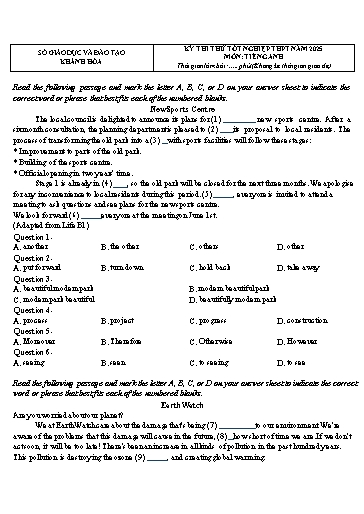
 KỲ THI THỬ TỐT NGHIỆP THPT NĂM 2025
 SỞ GIÁO DỤC VÀ ĐÀO TẠO
 MÔN: TIẾNG ANH
 KHÁNH HÒA
 Thời gian làm bài: ..... phút (Không kể thời gian giao đề)
 Read the following passage and mark the letter A, B, C, or D on your answer sheet to indicate the
 correct word or phrase that best fits each of the numbered blanks.
 New Sports Centre
 The local council is delighted to announce its plans for (1) new sports centre. After a
 sixmonth consultation, the planning department is pleased to (2) its proposal to local residents. The
 process of transforming the old park into a (3) with sports facilities will follow these stages:
• * Improvements to parts of the old park.
• * Building of the sports centre.
• * Official opening in two years' time.
 Stage 1 is already in (4) , so the old park will be closed for the next three months. We apologise
 for any inconvenience to local residents during this period. (5) , everyone is invited to attend a
 meeting to ask questions and see plans for the new sports centre.
 We look forward (6) everyone at the meeting on June 1st.
 (Adapted from Life B1)
 Question 1.
 A. another B. the other C. others D. other
 Question 2.
 A. put forward B. turn down C. hold back D. take away
 Question 3.
 A. beautiful modern park B. modern beautiful park
 C. modern park beautiful D. beautifully modern park
 Question 4.
 A. process B. project C. progress D. construction
 Question 5.
 A. Moreover B. Therefore C. Otherwise D. However
 Question 6.
 A. seeing B. seen C. to seeing D. to see
 Read the following passage and mark the letter A, B, C, or D on your answer sheet to indicate the correct
 word or phrase that best fits each of the numbered blanks.
 EarthWatch
 Are you worried about our planet?
 We at EarthWatch care about the damage that's being (7) to our environment. We're
 aware of the problems that this damage will cause in the future, (8) how short of time we are. If we don't
 act soon, it will be too late! There's been an increase in all kinds of pollution in the past hundred years.
 This pollution is destroying the ozone (9) , and creating global warming. It's not going to be easy to save the Earth from (10) , but we have to try. If you're
enthusiastic about fighting for the only planet (11) , we've got, then we want to hear from you!
Think about it! You can't escape from the facts. The Earth is in (12) and it's going to take every single
one of us to help save it. Join us today!
(Adapted from Destination B1)
Question 7. A. done B. laid C. made D. put
Question 8. A. show B. showing C. showed D. to show
Question 9. A. system B. surface C. layer D. area
Question 10. A. destruction B. destroying C. destroyed D. destructive
Question 11. A. whom B. that C. what D. where
Question 12. A. risk B. threat C. danger D. stake
Mark the letter A, B, C, or D on your answer sheet to indicate the best arrangement of utterances or
sentences to make a meaningful exchange or text in each of the following questions.
Question 13.
a. Harry: Really? What did you buy?
b. Harry: Hi Megan. What did you do last weekend?
c. Megan: I went shopping on Saturday.
A. b - a – c B. a - b- c C. b - c – a D. c – b - a
Question 14.
a. Michelle: Thanks for inviting me. Sorry I'm late — I was stuck in traffic.
b. Harris: My favorite whiskey? You shouldn't have! Thank you, Michelle.
c. Michelle: I brought you a little gift. Hope you like it.
d. Harris: No worries. Come on in and make yourself at home.
e. Michelle: How's your wife and the twins in Australia?
A. a – c – b - d – e B. c – b – a – e - d C. a - d - e - c – b D. a - d - c-b - e
Question 15. Dear Sabrina.
a. In PE, we often play basketball, which is my favourite sport.
b. Thanks for your letter. It was great to hear from you.
c. One reason I like Friday is because I have PE and chemistry.
d. On Friday evenings, I play football or go to a party with friends.
e. You asked me about my favourite day — it's definitely Friday.
f. Write and tell me about your favourite day!
A. b - e - a - c-d -f B. e -b -c-d -a -f C. b - c-e-a -d -f D. b-e-c-a -d -f
Question 16.
a. First of all, keep track of the time you spend on practice Tasks 1 and 2 so you know how long each task
usually takes you.
b. Finally, once you've finished both tasks, compare your answers with the model responses to assess
your timing and accuracy.
c. In the real test, you will complete both writing tasks within one hour, without a break. d. Before moving on to Task 2, you may want to reflect on your Task 1 performance and use the feedback
to improve.
e. Writing Task 1 in the IELTS Academic test requires both time awareness and effective practice
strategies.
A. e - c - a - d – b B. e - a – c - d -b C. c - e- a - d – b D. a - e - d - c - b
Question 17.
a. Garbage collectors visit neighborhoods around every other day, and if they miss a day, garbage can
quickly overflow, attracting stray animals and causing health risks.
b. Although their job is tiring and often unpleasant, they carry it out with dedication, and we try to be
respectful of their efforts.
c. It is surprising how much rubbish we throw away, and we often don't notice it until the bins are full.
d. To show appreciation, some families offer them water, a smile, or even a few kind words during their
routine visits.
e. Ultimately, their work might go unnoticed at times, but it plays a vital role in protecting our
environment and public health respectful of their efforts.
A. c- a – b - d - e B. c – b – a - d – e C. c - a - d – b - e D. a – c - b - d - e
Read the following passage and mark the letter A, B, C, or D on your answer sheet to indicate the correct
word or phrase that best fits each of the numbered blanks.
 Nature Makes You "Feel More Alive"
 With all these benefits of being out in nature, it's probably no surprise that (18) .Being outdoors
gives us energy, makes us happier, helps us relieve the everyday stresses of our over-scheduled lives,
opens the door to creativity, and helps us be kind to others.
 No one knows if there is an ideal amount of nature exposure, though Strayer says that longtime
backpackers suggest a minimum of three days to unplug from our everyday lives. Nor can anyone say
how nature compares to other forms of stress relief or attention restoration, such as sleep or meditation.
Both Strayer and Bratman say we need more careful research (19) .
 Still, the research does suggest there is something about nature that keeps us psychologically
healthy, and that is good to know, especially since nature is a resource that is free and (20) . Results
like these should encourage us as a society to consider more carefully how we preserve our wilderness
spaces and our urban parks.
And while the research may not be conclusive, Strayer is optimistic (21) ______ that there is something
about nature that renews us, allowing us to feel better, to think better, and to deepen our understanding of
ourselves and others.
 "You can't have centuries of people writing about this and not have something going on," says
Strayer. "If you are constantly on a device or in front of a screen, (22) ."
(Adapted from https://www.dailygood.org)
Question 18.
A. something makes us feel more alive and vital about nature
B. nature makes something about us feel more alive and vital C. nature makes us feel more alive and vital about something
D. something about nature makes us feel more alive and vital
Question 19.
A. before we came to any definitive conclusions to tease out these effects
B. to tease out these effects before we come to any definitive conclusions
C. that these effects tease out before we come to any definitive conclusions
D. which tease out these effects before we come to any definitive conclusions
Question 20.
A. that much people can access by walking out the door
B. that many of us can access by just walking outside our door
C. which many of us can be accessed by just walking outside our door
D. which many people can reach by walking out the dooổ
Question 21.
A. that science will finally show what we've believed for a long time
B. that science will show finally what we believed since long time
C. that science will to show what we have believed for so long time
D. that science finally will show what have we believed for a long time
Question 22.
A. pretty spectacular: the real world is that you're missing out on something
B. something that is pretty spectacular: the real world you're missing out on
C. you're missing out on pretty spectacular something that is: the real world
D. you're missing out on something that is pretty spectacular: the real world
Read the following passage and mark the letter A, B, C, or D on your answer sheet to indicate the best
answer to each of the questions.
 Emma Giorgio, star of the hot new romance movie Blue Night, lives in Ventura, a suburb of Los
Angeles. With both parents working in the entertainment industry, getting involved in acting seemed like
a natural move for Emma. What began as a role for a girl in a soft drink commercial has now blossomed
into a successful career as one of Hollywood's leading young ladies. Emma talked to us at Hip Magazine
last month and discussed her career, as well as revealing details about her family life.
 "It was hard work, but an incredible experience, and I loved every minute of it," Emma replied
when asked what it was like to star in her first film. "Doing this movie, we all spent so many hours and
months working together. I feel like the cast and crew are another family now." She explained that even
though the filming schedule was demanding, the friendships she built on set made the experience
unforgettable.
 Emma shares the Giorgio house with her mother, father, and her younger brother in Ventura,
California. The Giorgios have two little dogs, and Emma walks them almost every day for exercise. In
the summer, she also likes to go with friends to the Pacific beach, about a mile from their family home.
These quiet routines give her a welcome break from the pressures of acting life.
 In her time off from acting, Emma says what she likes to do most is to relax now that she has completed her high school studies. She enjoys modern literature and film, and is considering pursuing a
degree in the arts. Emma shared that she has a passion for reading romantic fiction, too, and hopes to one
day create her own works. For her, writing would be another way to tell meaningful stories and connect
with others.
(Adapted from https://www.msu-exams.gr)
Question 23. The word “revealing” in paragraph 1 could be best replaced by .
A. sharing B. editing C. hiding D. imagining
Question 24. Which of the following best paraphrases the underlined sentence in paragraph 2?
A. The experience was fun because there wasn't much hard work involved.
B. Despite the challenges, Emma thoroughly enjoyed her experience.
C. Although Emma found the work to be difficult, it wasn't the best experience she's had.
D. Emma found the work difficult and did not enjoy it very much.
Question 25. The word “them” in paragraph 3 refers to .
A. friends B. cast and crew C. dogs D. school studies
Question 26. The word “passion” in paragraph 4 is OPPOSITE in meaning to .
A. dislike B. love C. interest D. joy
Question 27. According to the passage, to Emma Giorgio, .
A. Blue Night was her first major film role
B. the cast and crew are her relatives
C. acting was never challenging or difficult for her
D. a degree in the arts seems unsuitable
Question 28. Which of the following is mentioned in the passage about Emma's hobbies?
A. She likes reading romantic fiction and modern literature.
B. She often goes to acting workshops in her free time.
C. She prefers outdoor sports to indoor activities.
D. She enjoys spending time at the beach with her dogs
Question 29. In which paragraph does the writer mention Emma's possible future studies?
A. Paragraph 4 B. Paragraph 2 C. Paragraph 1 D. Paragraph 3
Question 30. In which paragraph does the writer mention Emma's daily activities outside of acting?
A. Paragraph 3 B. Paragraph 1 C. Paragraph 4 D. Paragraph 2
Read the following passage and mark the letter A, B, C, or D on your answer sheet to indicate the best
answer to each of the questions.
 Friendly Robots - A Blessing or a Danger?
 Robots have fascinated humans for decades, often appearing in films and books as either helpful
companions or dangerous machines. [I] In some stories, robots assist families with daily tasks and are
treated with affection. [II] In others, they are emotionless beings that follow orders without mercy. [III]
These mixed portrayals make us wonder how we truly feel about the rise of social robots. [IV] Fictional
examples like Rosie from The Jetsons show how robots can become part of the family, while darker
images in movies like Minority Report portray them as tools of control and fear. Dr. David Hanson, a robot designer, believes robots can become our friends if they are designed
properly. He is working on developing machines that can read human facial expressions, understand
emotions, and respond appropriately. His Albert Hubo robot, with the face of Albert Einstein, can smile
or frown depending on how people interact with it. Such human-like features help people feel more
comfortable when interacting with machines. These robots are not only advanced in their expressions but
also aim to create trust and empathy in human-robot interactions.
 To create robots that seem lifelike, Hanson's team has collaborated with the University of California
to develop software called the Character Engine. This technology allows robots to detect eye movement,
head position, and facial expressions. As a result, the robots can mimic human behavior and adjust their
responses in real time, improving communication. These developments suggest that the boundary between
programmed behavior and emotional intelligence is gradually being bridged by technology.
 In addition to facial recognition, Hanson's robots can speak and respond to questions. While some
replies may seem memorized at first, the robots can learn from conversations and even search the Internet
to provide better answers. Over time, their responses become more personalized, making them feel lik
intelligent companions. This learning process mirrors how humans adapt their communication styles in
social settings, further blurring the line between machine and human interaction.
 However, not everyone agrees that friendly robots are harmless. Psychologist Sherry Turkle warns
that these machines might replace real friendships. In her view, depending on robots for emotional
support could leave people feeling more isolated in the long run. Her concern reminds us to think
arefully about how we use technology and whether it brings us closer together or drives us further
apart. The emotional risks of robotic companionship should be considered alongside the technological
benefits.
Question 31. Where in paragraph 1 does the following sentence best fit? This contrast shows our uncertain
attitude toward robotic companions.
A. [III] B. [II] C. [I] D. [IV]
Question 32. The word “portrayals” in paragraph 1 is closest in meaning to ______.
A. emotions B. descriptions B. predictions C. reactions
Question 33. According to paragraph 2, what is Hanson's goal in designing human-like robots?
A. To allow robots to take over repetitive human jobs.
B. To help people feel emotionally connected to robots.
C. To help robots become faster, stronger and friendlier.
D. To teach robots how to repair themselves properly.
Question 34. The word “they” in paragraph 2 refers to .
A. machines B. robots C. friends D. emotions
Question 35. What is the purpose of the Character Engine software mentioned in paragraph 3?
A. To teach robots how to paint pictures using creative techniques.
B. To help robots imitate human behavior during interaction.
C. To make robots more resistant to malfunction in real time.
D. To improve robot movement in extremely dangerous areas.
Question 36. The word “personalized” in paragraph 4 is OPPOSITE in meaning to . A. relevant B. responsive C. general D. specificresponsive
Question 37. Which of the following is TRUE according to paragraph 4?
A. Robots do not have access to the Internet.
B. Robots never sound like they are programmed.
C. Robots can change their answers based on what they learn.
D. Robots ignore users' input when giving answers.
Question 38. Which of the following best paraphrases the underlined sentence in paragraph 5?
A. She claims frequent use of technology always helps people feel more connected and supported.
B. She believes technology always damages relationships and weakens people's connection with others.
C. She wants people to use less technology to stay more connected with their families and friends.
D. She warns that how we use technology can either bring us closer or push us further apart.
Question 39. What can be inferred from paragraph 5?
A. People are becoming more emotionally intelligent thanks to robots.
B. The public strongly supports robot companionship.
C. Friendly robots are guaranteed to improve social well-being.
D. Overreliance on robots may lead to emotional disconnection.
Question 40. Which of the following best summarises the passage?
A. Robots could soon take over many forms of human communication and bonding.
B. Human-like robots may pose risks and should not be trusted blindly.
C. As robots grow more lifelike, we must weigh benefits against emotional harm.
D. Today's social robots often serve roles in fun and leisure activities. ĐÁP ÁN
 1. A 2. A 3. A 4. C 5 .D
 6. C 7. A 8. B 9. C 10. A
 11. B 12. C 13. C 14. D 15. D
 16. A 17. A 18. D 19. B 20. B
 21. A 22. D 23. A 24. B 25. C
 26. A 27. A 28. A 29. A 30. A
 31. A 32. B 33. B 34. B 35. B
 36. C 37. C 38. D 39. D 40. C
* Giải chi tiết
 Câu Giải thích Kiến thức
 1-A Question 1. Other(s),
 A. another Another, và The
 B. the other Other(s)
 C. others
 D. other
 Giải thích:
 A. another: dùng để nói về một cái khác nữa, phù hợp với danh từ đếm được số ít
 như “sports centre”.
 B. the other: dùng để chỉ “cái còn lại trong hai cái”, không phù hợp trong ngữ cảnh
 này vì không có so sánh 2 trung tâm nào.
 C. others: đại từ, dùng để thay thế cho danh từ số nhiều đã biết, không đứng trước
 danh từ.
 D. other: tính từ, đi với danh từ đếm được số nhiều/danh từ không đếm được
 Chọn A
 2-A Question 2. Cụm động từ
 A. put forward
 B. turn down
 C. hold back
 D. take away
 Giải thích:
 A. put forward: đề xuất, đưa ra (ý tưởng, kế hoạch). → phù hợp ngữ cảnh.
 B. turn down: từ chối.
 C. hold back: kìm hãm, giữ lại.
 D. take away: lấy đi.
 Dịch: phòng quy hoạch vui mừng được đưa ra đề xuất của mình cho cư dân địa
 phương.
 Chọn A
 3-A Question 3. Trật tự từ A. beautiful modern park
 B. modern beautiful park
 C. modern park beautiful
 D. beautifully modern park
 Giải thích:
 A. beautiful modern park: đúng trật tự tính từ trong tiếng Anh: Opinion (beautiful)
 + Fact (modern) + Noun (park).
 Chọn A
4-C Question 4. Cụm từ
 A. process
 B. project
 C. progress
 D. construction
 Giải thích:
 Be in progress: được tiến hành = be under construction – be underway = be taking
 place
 Chọn C
5-D Question 5. Liên từ
 A. Moreover
 B. Therefore
 C. Otherwise
 D. However
 Giải thích:
 A. Moreover: hơn nữa, không phù hợp vì không bổ sung lý do.
 B. Therefore: vì vậy → không logic với nội dung.
 C. Otherwise: nếu không thì → không đúng ngữ cảnh.
 D. However: tuy nhiên – phù hợp khi chuyển ý từ việc “xin lỗi vì sự bất tiện” sang
 việc “mời tham gia họp”.
 Chọn D
6-C Question 6. Cụm từ
 A. seeing
 B. seen
 C. to seeing
 D. to see
 Giải thích:
 “Look forward to” + V-ing → phải dùng “to seeing”
 Chọn C
7-A Question 7. Cụm động từ
 A. done
 B. laid C. made
 D. put
 Giải thích:
 cause/do damage: gây thiệt hại, gây hư hại
 Chọn A
 8-B Question 8. Rút gọn mệnh
 A. show đề
 B. showing
 C. showed
 D. to show
 Giải thích:
 Cần mệnh đề quan hệ thay thế cho cụm đằng trước, dạng đầy đủ là “which shows”
 → rút gọn: showing
 Chọn B
 9-C Question 9.
 A. system
 B. surface
 C. layer
 D. area
 Giải thích:
 ozone layer: tầng ozone
 Chọn C
10-A Question 10. Cụm từ
 A. destruction
 B. destroying
 C. destroyed
 D. destructive
 Giải thích:
 Sau giới từ “from + N”
 Chọn A
11-B Question 11.
 A. whom
 B. that
 C. what
 D. where
 Giải thích:
 A. whom: dùng cho người → sai.
 B. that: đại từ quan hệ chỉ vật → đúng.
 C. what: không dùng như đại từ quan hệ trong câu này.
File đính kèm:
- de_thi_thu_tot_nghiep_thpt_2025_mon_tieng_anh_sgd_khanh_hoa.docx

